
How Lack of Sleep Affects Brain Function and Health
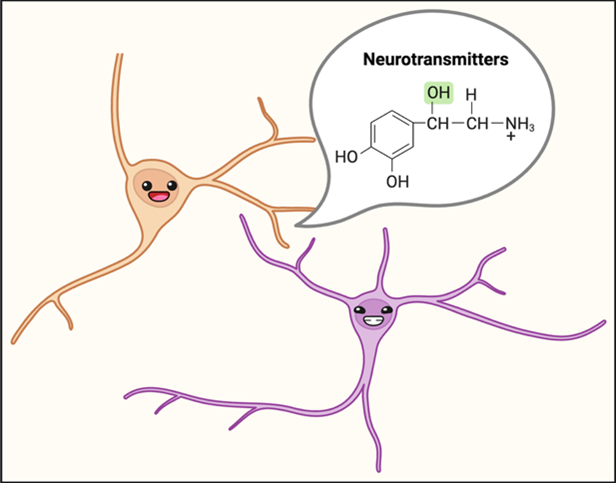
Neurotransmitters are chemicals secreted by brain cells (neurons) that transmit messages to other
neurons or cells. Created with BioRender.com
By Kennedy Koopman
March 16, 2026
The human body requires sleep to function properly. When sleep is insufficient, ranging from a few nights of limited rest to complete sleep deprivation, adverse effects begin to emerge in the body.
For anyone, but especially for active students, this can be detrimental. Because of that, the goal of this article is to give you an overview of the effects of sleep deprivation on the brain and briefly the cardiovascular system and metabolic function.
The Brain
Lack of sleep affects brain function negatively in many different ways. To start, the brain becomes less able to adjust the connections between its cells, a process known as synaptic plasticity, which is essential for learning and memory.2 In this way, the lack of sleep can make more difficult to learn new information and retain what we have learned. Sleep loss also reduces activity in the hippocampus, which can impair learning and memory consolidation while also causing difficulties in handling stress and processing emotional memories, due to its close relationship with the amygdala, the brain’s emotion center.2 Moreover, sleep deprivation also decreases activity in the prefrontal cortex, a brain area that controls emotions, reasoning, and decision-making. These changes can lead to increased impulsivity, more frequent mistakes, and
reduced ability to focus.1
How does sleep loss affect the brain at the molecular level? When we lack sleep, our brain undergoes changes in the chemical messengers it uses to communicate
(Fig.1). These changes are complex and vary across different brain regions and over time. The mechanisms described here are simplified to provide a general
conceptual overview. One key change involves adenosine, a chemical in the brain that starts to build up during prolonged wakefulness, making us feel mentally
tired.4 At the same time, GABA, a calming chemical, becomes reduced in some brain areas, which makes it harder for the brain to get out of stress mode and relax.2
Glutamate, an excitatory chemical, becomes increased overstimulating brain cells and interfering with learning and memory.5 Other important chemicals like dopamine, norepinephrine, and serotonin also get out of balance, which can cause mood swings, anxiety, and irritability.8
Fig. 1 Neurotransmitters are chemicals secreted by brain cells (neurons) that transmit messages to other neurons or cells. Created with BioRender.com
Sleep loss also affects hormones. Cortisol (stress hormone) rises, which can hurt our memory and make our mood worse.1 Meanwhile, growth hormones and melatonin secretion are also disrupted, which contributes to our sleep quality and repair in our brain.4
There is a lot that goes on in our brains when we don’t sleep, but that’s not all. The brain also clears out dangerous proteins when we sleep, so without sleep they do not clear as often, which increases the risk for brain diseases such as Alzheimer's.7
Other Body Systems
Now that we know how sleep deprivation affects the brain, we can look at how it influences the rest of the body too. The cardiovascular system is composed by heart, blood vessels and blood. This system is responsible for moving blood throughout the body to deliver oxygen and nutrients and to carry away waste. As we discussed earlier, not getting enough sleep can throw our hormones and neurotransmitters out of balance. Higher levels of cortisol and norepinephrine, triggered by sleep deprivation, activate the body’s “fight or flight” system, affecting heart and vascular function, leading to increased heart rate and blood pressure.9 Together, this can put extra strain on the cardiovascular system, which, over time, can damage it. When we don't get enough sleep increases the risk of heart problems, including high blood pressure,
stroke, and heart attacks.2,3,6
Another physical change associated with sleep deprivation is an impairment of the metabolic function. Metabolic function is how your body turns food into energy and uses it to stay alive and healthy. With sleep loss, the body becomes less sensitive to insulin, a master hormone that regulates the sugar (glucose) metabolism, making it harder for cells to take up sugars and increasing risk for type 2 diabetes.9 Appetite hormones are also affected by sleep deprivation as well. For example, leptin a hormone which signals fullness, decreases, and ghrelin a hormone which signals hunger, increases.4 This combination boosts appetite, which can cause overeating and weight gain- increasing the risk to develop obesity.
Conclusion
Sleep is critical for anyone. A lack of sleep negatively affects the brain, impairing memory, learning, and emotional regulation. It also harms other organs and systems in the body, creating an overall imbalance in physical and mental health. The good news is that the solution is straightforward: most adults benefit from
approximately 7–9 hours of sleep per night.
Acknowledgment
Kennedy Koopman is a Doctor of Physical Therapy student at ISU. This article is the result of a research literature project led by Dr. Lizbeth de la Cruz (Biological Sciences). It was edited, reviewed, and prepared with additional contributions from Dr. Sherry Adams (Biological Sciences) and Dr. Tarang Jain (Physical Therapy and Athletic Training). Logan McDougall and Bentley Parrot provided feedback to strengthen the writing.
References
- Alhola and Polo-Kantola. Sleep Deprivation: Impact on Cognitive Performance. Neuropsychiatric Disease and Treatment, 2007. https://pmc.ncbi.nlm.nih.gov/articles/PMC2656292/
- Alkadhi, et al. Neurobiological Consequences of Sleep Deprivation. Current Neuropharmacology, 2013. https://pmc.ncbi.nlm.nih.gov/articles/PMC3648777/
- Backman. Poor Sleep May Increase Markers of Poor Brain Health, New Study Finds. Yale School of Medicine, 2024. https://medicine.yale.edu/news-article/poor-sleep-may-increase-markers-ofpoor-brain-health-new-study-finds/
- Banks and Dinges. Behavioral and Physiological Consequences of Sleep Restriction. Journal of Clinical Sleep Medicine, 2007. https://pubmed.ncbi.nlm.nih.gov/17803017/
- Boonstra, et al. Effects of Sleep Deprivation on Neural Functioning: An Integrative Review. Cellular and Molecular Life Sciences, 2007. https://link.springer.com/article/10.1007/s00018-007-
6457-8 - Garbarino, et al. Role of Sleep Deprivation in Immune-Related Disease Risk and Outcomes. Communication Biology, 2021. https://pubmed.ncbi.nlm.nih.gov/34795404/
- Khan and Al-Jahdali. The Consequences of Sleep Deprivation on Cognitive Performance. Neurosciences (Riyadh), 2023. https://pmc.ncbi.nlm.nih.gov/articles/PMC10155483/
- Krause, et al. The Sleep-Deprived Human Brain. Nature Reviews Neuroscience, 2017. https://pmc.ncbi.nlm.nih.gov/articles/PMC6143346/
- Medic, et al. Short- and Long-Term Health Consequences of Sleep Disruption. Nature and Science of Sleep, 2017. https://pubmed.ncbi.nlm.nih.gov/28579842/