
Strong Bones: How To Safely Exercise to Improve Strength, Balance, and Confidence with Osteoporosis
Seth Hampton, PT, DPT, OCS
“Use it or lose it!” We’ve all heard the phrase. Maybe your gym-loving neighbor was trying to encourage you to exercise, or your HR team was giving you the bad news that your PTO would expire at the end of the year. Leonardo da Vinci expressed a similar idea hundreds of years ago when he wrote, “...even so does inaction sap the vigor of the mind.”
When it comes to our bodies, we usually think about this principle in relation to our muscles. If you don’t challenge your muscles, they gradually become weaker. But the same basic principle applies to your bones.
Your Bones Are Not Glass
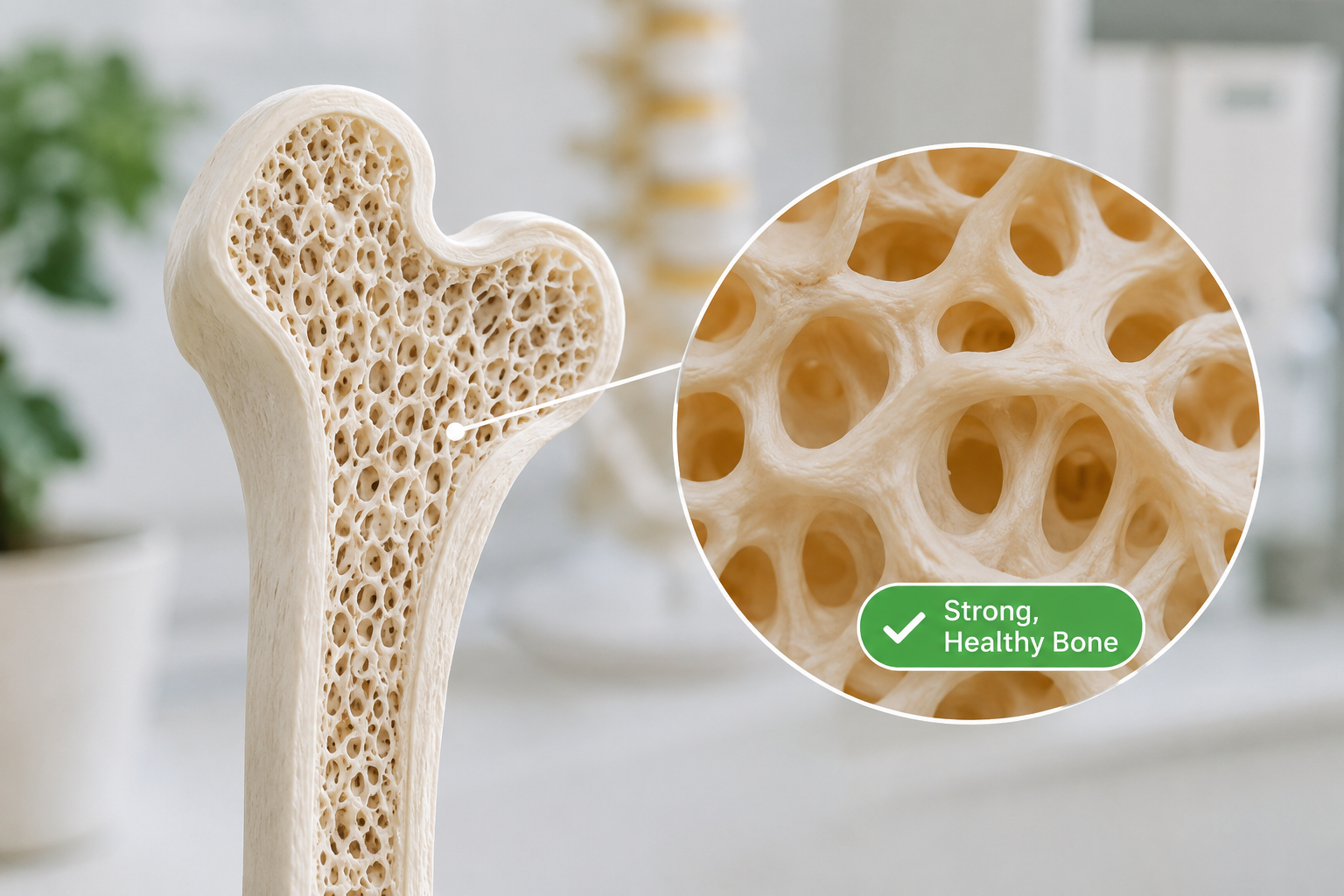
Osteoporosis translates to “porous bone.” This diagnosis indicates that your bones have lost enough density and strength that they are more vulnerable to fracture. If you’ve received an osteoporosis diagnosis, it is completely understandable to feel worried.
Maybe you have already experienced a compression fracture in your spine or a fracture of your hip or wrist. Maybe you simply saw the results of your bone-density scan and suddenly started wondering whether bending, lifting, or exercising was still safe. That fear can unfortunately lead people to avoid exercise and activities they enjoy.
But your bones are not glass.
Bone is living tissue. It responds to the forces placed upon it. Your muscles can become stronger when you train them, and your bones can also adapt when they are challenged appropriately.
The goal after an osteoporosis diagnosis is not to stop loading your body. The goal is to learn how to challenge it safely and progressively.
Should I Still Exercise? What Exercises Can I Do?
If there is one message to retain from this article, please remember that, yes, you can and should still exercise. Even with a diagnosis of osteoporosis. Especially with a diagnosis of osteoporosis!
Exercise is one of the most important tools we have for maintaining muscle and bone strength, improving balance, preserving independence, and reducing factors that contribute to falls and fractures.
Several major exercise studies, including Osteo-cise, LIFTMOR, EFOPS, and MEDEX-OP, have demonstrated that appropriately designed exercise programs can improve bone density, strength, balance, physical function, and other factors related to fracture risk. Long-term research has also shown that regular exercise can help reduce fractures.
Although the exact programs differ, they commonly emphasize three major ingredients:
- Resistance training
- Balance exercise
- Impact activity
Resistance training. Resistance training challenges your muscles to produce force. As those muscles contract, they pull on the bones they attach to. Those forces are part of the signal that tells your muscles and bones, “We need to stay strong enough to handle this.”
Compound movements are the exercises most often used in research studies for osteoporosis patients as they tend to have the most impact on strength, balance, and bone density. Compound movement simply refers to exercises that involve the use of multiple joints and muscles. Some of the most common compound exercises include squats, overhead press, rows, deadlifts, pulldowns, and carries, among others.
If those exercises sound intimidating, remember you do not need to start heavy.
You might begin with body weight, resistance bands, light dumbbells, or exercise machines. The important part is starting at a level you can perform confidently and then gradually making the exercise more challenging as your body adapts.
Over time, the goal is to work toward weights that actually feel challenging. Research such as the LIFTMOR and MEDEX-OP trials suggests that appropriately supervised heavier resistance training can produce meaningful improvements in bone density and strength.
That does not mean you need to walk into the gym tomorrow and start lifting the heaviest thing you can find. Start small. Build gradually.
If you stick with resistance training for the long run, you’ll be surprised by how much progress you can make, and what seems intimidating now will become reasonable or even easy months and years later.
A simple starting point might be one set of 8–12 repetitions of several exercises once or twice per week. As that becomes comfortable, gradually work up to two or three challenging sets of each exercise, resistance training two or three days per week.
When an exercise becomes consistently easy, increase the resistance by a small amount and see how your body responds. That might mean adding only a few pounds rather than making a giant leap. It’s normal to experiences some muscle soreness after beginning a new strength program. New, sharp, severe, persistent, or very localized pain is different and deserves more caution and possibly a visit to your provider.
You’ll be in a good position to safely progress your exercise if you remember that your goal is not to prove how much weight you can lift. Your goal is to signal your body to adapt and strengthen beyond what you were capable of before.
For more specific direction and help, our ISU Physical Therapy team created a series of videos demonstrating several helpful strength, balance, impact, bending, and lifting exercises for people who want to prevent or manage osteoporosis.
You can watch the full playlist here: Using Exercise to Manage Osteoporosis
Balance exercise. Osteoporosis is sometimes referred to as a “silent disease,” because you may not know your bones have lower density until a fracture occurs. Many osteoporosis fractures happen during a fall. That means improving your ability to stay on your feet is every bit as important as strengthening the bones themselves.
Resistance training helps. Stronger legs and hips make it easier to stand, walk, play pickleball, climb stairs, and react when you lose your balance. You can also train balance directly.
Balance can be made more challenging in several ways. You can:
- Narrow your stance
- Stand with one foot in front of the other
- Stand on one leg
- Stand on an unstable surface
- Move your head or arms
- Close your eyes
- Practice reaching or stepping
- Reduce how much you rely on your hands for support
Start with a challenge that makes you work but still allows you to feel safe. If your balance is poor, practice near a sturdy counter, wall, between chairs, or have another person nearby. There is no trophy for turning a balance exercise into an actual fall.
Once you find a position that is challenging, a simple starting goal is to accumulate 1-2 minutes of practice each day. As you become more steady, make the exercise a little harder using any of the options listed above. You’ll also find more instructions on how to do these balance exercises in our video playlist linked previously.
Balance improvements often come slowly, so be patient with yourself and stick with it.
Impact activity. “Ready to try some impact exercises?” One of the osteoporosis patients in our clinic was understandably hesitant when asked this question. When she learned step 1, dropping back onto her heels with her hands holding onto a counter, she turned and stated, “That’s it?” Impact exercise does not have to start with jumping off boxes or running down a mountain. Just like with resistance and balance exercise, and impact training is about starting wherever you are. Simple and easy at first, allowing your body to adapt and your confidence to grow.
Impact activities, just like resistance exercise, can lead to the bone strengthening effects we desire. Walking is excellent exercise and provides many health benefits. But walking alone may not provide enough stimulus to maximize bone strength in important areas such as the hips and spine.
A simple progression could look something like the following:
- Walking
- Heel drops
- Stomping
- Very small jumps with hands supported on a counter
- Unsupported small jumps or hops
- Running (or pickleball)
If jumping and running sound intimidating, remember you don’t have to start at the end of that list…you start at the beginning.
It’s reasonable to begin with 5–10 gentle impacts once or twice per week. If that goes well, you can gradually work toward more repetitions, 25-30, and eventually two or three sessions per week.
People with a recent fracture, previous hip or spinal fractures, multiple fragility fractures, significant balance problems, or other medical concerns may need their impact exercises modified. If you are unsure which level is appropriate, a healthcare provider or physical therapist can help you find a safe starting point.
The Biggest Obstacle: Getting Started
You do not need to suddenly spend five days per week in a gym. Start with one or two days, choose a few exercises, and practice them consistently. As your strength and confidence improve, gradually increase weight, repetitions, sets, balance challenge, or impact level.
Six months from now, exercises that currently sound intimidating may feel completely normal. Seeing that progress is one of the best parts about training and exercise.
If Leonardo da Vinci had been an osteoporosis expert, he might have written, “...even so does avoiding exercise sap the density of the bones.”
It is normal to feel nervous after an osteoporosis diagnosis. You may have spent months or years being told to “be careful.” Suddenly being told to lift weights, challenge your balance, or perform impact activities can sound like the exact opposite of being careful.
But avoiding movement is not the same thing as protecting yourself. Learning to move well, becoming stronger, improving your balance, and safely preparing your body for the demands of everyday life can make you more capable and resilient.
If you’re still worried, please know that you do not have to figure it out alone.
If you would like individualized help, even one or two visits with a physical therapist can help you learn safe technique, choose the right starting exercises, and build a plan that fits your current abilities and goals.
We’re ready to help. You can schedule an appointment at Idaho State University’s Physical Therapy Clinic in Meridian by calling (208) 373-1734.
And you can watch our free exercise demonstrations here: Using Exercise to Manage Osteoporosis
Your bones are not glass. Start where you are, build gradually, and give your body the chance to become stronger.