
Articulation Agreements
For detailed information about ISU's Articulation Agreement Process, please check the ISU Articulation Agreement Manual.
Articulation Form - Revised Fall 2025 (Please download and complete this form in Microsoft Word)
Articulation Degree Plans will be added to the Transfer Agreements website.
If you have further questions, please email articulations@isu.edu.
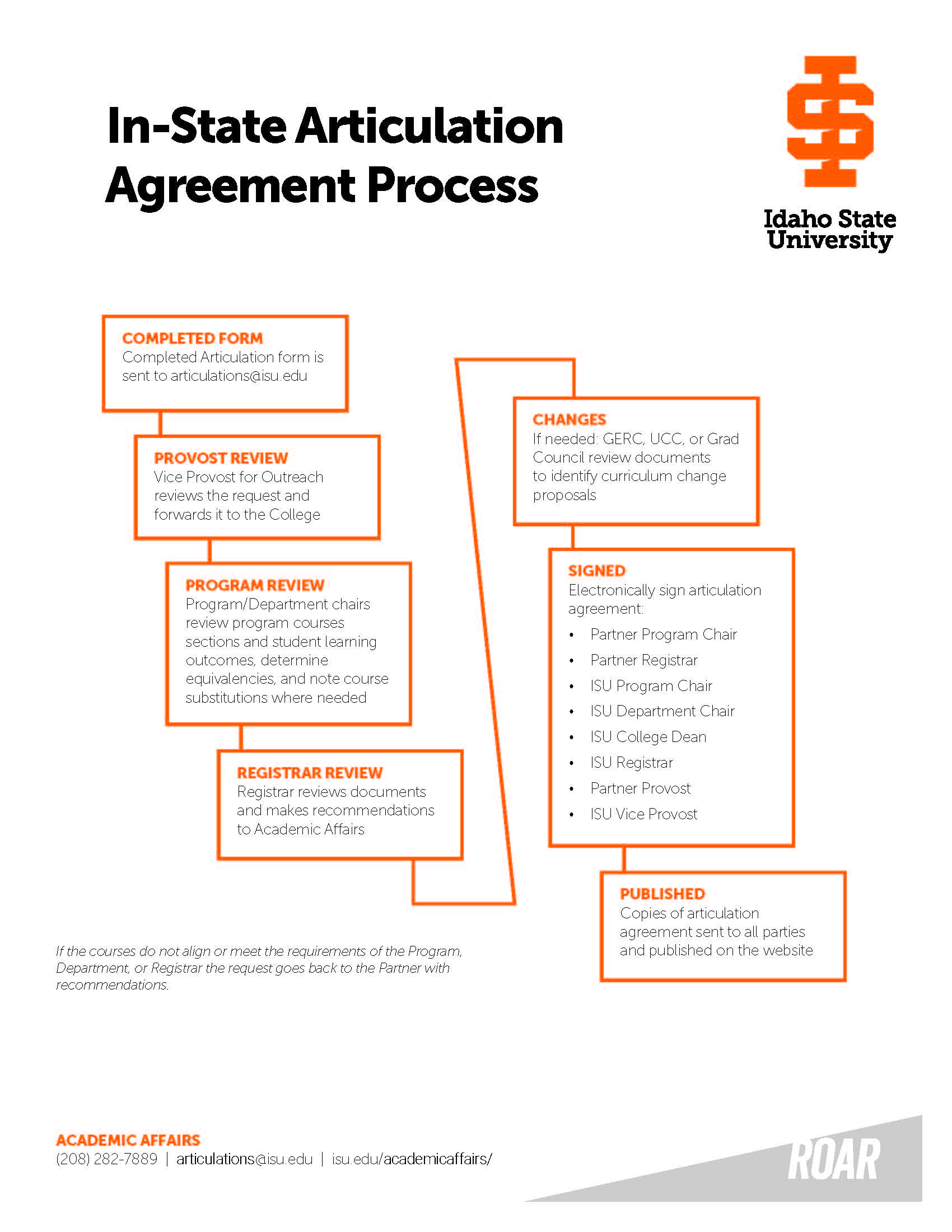
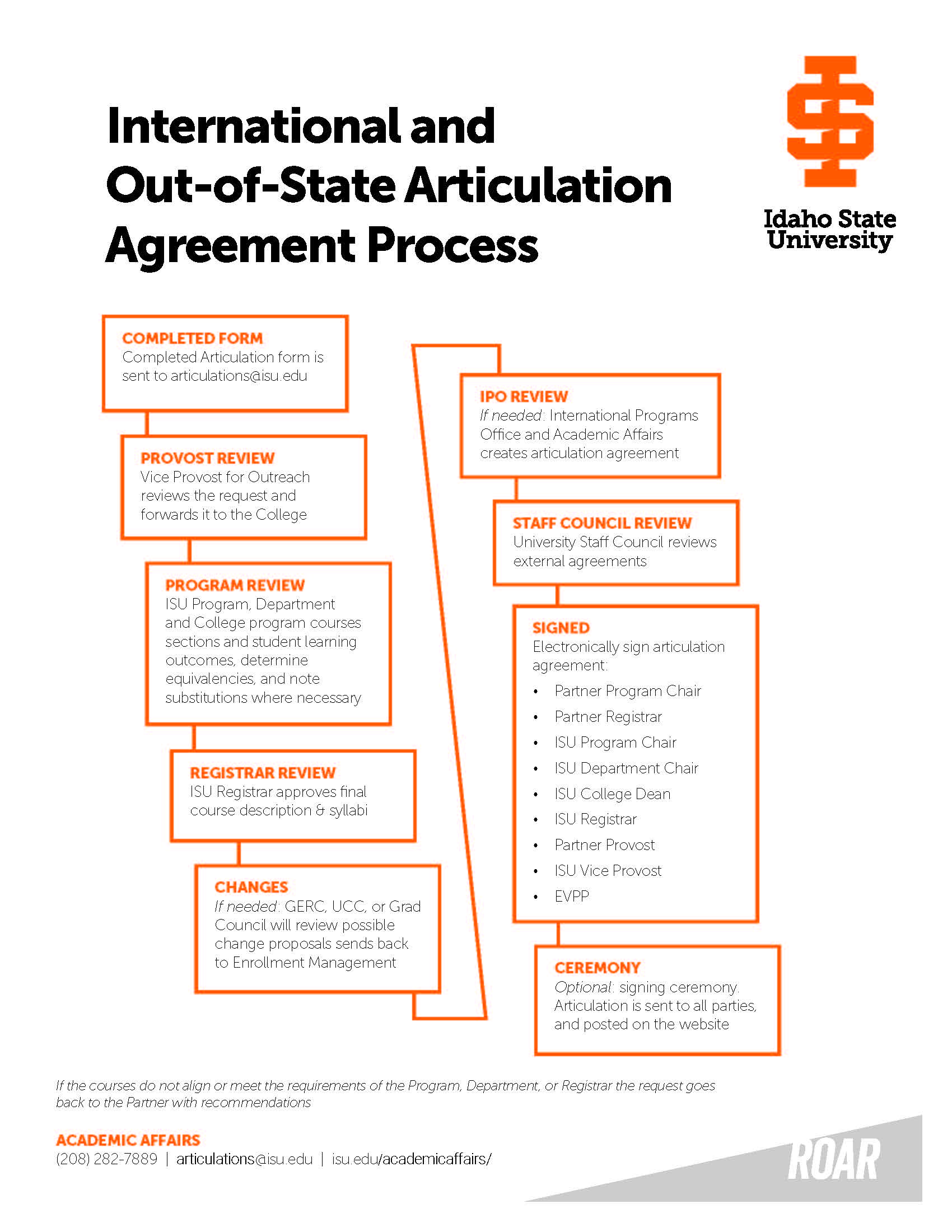
Partnerships (Articulations, MOUs, Pathways)
The following definitions have been adopted by Academic Affairs and are intended to guide the development, documentation, and implementation of a variety of partnerships. It is important to keep in mind that any of the agreement types that follow CAN be legally binding depending on the obligations of any party and/or the language that is used to document the partnership. For this reason, it is crucial that individuals, departments, or colleges seeking to establish a partnership with external institutions or organizations follow the appropriate process for documenting the partnership and ensuring that all necessary parties at ISU have had the opportunity to review and approve the terms of the partnership.
Articulation Agreements
Definition: An articulation agreement is a formalized, documented partnership that outlines a cohesive educational program facilitated by departments or colleges at multiple institutions working together.
Purpose: Articulation agreements allow partner institutions to expand curricular, credential, or research opportunities for their students. In most cases, articulation agreements will have the primary purpose of clearly communicating how students’ work will transfer from one institution of higher learning to another, such as from a community college to a university, and how the transfer represents a single program of study.
Key Features: Articulation agreements typically address the following components, although this is not necessarily a comprehensive list.
- Course equivalencies
- Credit transfer
- Co-advising
- Co-curricular planning
- Number of students to be served by the agreement
- Eligibility for student and/or faculty participation
- Opportunities for faculty collaboration (may include research as well as coursework)
- Teach-out expectations
- Associated fees or waivers
- Legal obligations / considerations
- Signatures - attach list of signature authorities
- Duration and review
- Clinical component for a clinical site rotation defining student’s hands-on training
MOUs
Definition: A higher education Memorandum of Understanding (MOU) is a formalized, documented agreement between two or more higher education institutions that declares and outlines a collaborative partnership.
Purpose: The primary purpose of an MOU is to declare institutions’ intent to partner in particular areas and work toward particular goals. The MOU clarifies the intentions and responsibilities of the parties involved. It does not include course-level transfer information; rather, it serves as a public statement of the partnership, which may generate separate articulation agreements for specific departments or programs.
Key Features: MOUs typically address the following components, although this is not necessarily a comprehensive list.
- Collaboration areas
- Goals and objectives
- Roles and responsibilities
- Legal obligations / considerations (including teach-out requirements)
- Signatures - attach list of signature authorities
- Duration and review
Pathways
Definition: An educational pathway is a structured advising plan based on publicly-available information about program and course offerings at different institutions. No formalized agreement between institutions is necessary to create, use, or publicize a pathway.
Purpose: Pathways provide transparent, consistent information designed to help students, faculty, and staff facilitate a transfer from one institution to another. Because of this, pathways can be used as serious advising, planning, and marketing tools.
Key Features: Pathways typically address the following components, although this is not necessarily a comprehensive list.
- Course-level transfer equivalencies (for both general education and major courses)
- Additional coursework or credit requirements required to obtain a credential
- Estimated time to degree, if appropriate
- Instructions for ensuring that previous coursework is recognized appropriately by ISU
- Duration and review
Course Equivalencies
Definition: Course equivalencies are individual courses taught at other institutions that are determined by ISU faculty to achieve the same or similar learning objectives as a course offered by ISU. Equivalencies are based on stated course objectives from an academic catalog, an individual course description, and/or syllabus information. Course equivalencies are applied to a student’s record by the Office of the Registrar.
Purpose: Course equivalencies support student transfer by allowing students to apply work at other institutions to a program of study at ISU.
Key Features: Once a course equivalency has been defined and accepted by relevant faculty, the Office of the Registrar can apply that equivalency to the coursework of future transfer students.