
Current Connection: ISU Scientists Detail How Shifts in the Atlantic Ocean Impacted the Alaskan Climate 13,000 Years Ago
April 1, 2026
Some newly published findings from an Idaho State University professor and his colleagues are pointing out how changes to the currents an ocean away can impact climates on the other side of the globe.
A new paper published in Nature Communications explains how Bruce Finney, professor in the departments of biological sciences and geosciences at ISU, and his collaborators, Lesleigh Anderson, research geologist with the United States Geological Survey, and W. Brad Baxter, Idaho State alum, came to understand how shifts in currents in the Atlantic Ocean, led the climate of Alaska to cool especially in winter, roughly 13,000 years ago.
“In the Atlantic, off the east coast of the United States, the Gulf Stream flows north, delivering a lot of heat to northern latitudes,” said Finney. “This northward flow can be interrupted if a lot of freshwater is dumped into the North Atlantic in areas around Greenland. As glaciers melted at the end of the last ice age, a lot of freshwater was discharged into this region, halting the flow of heat northward. This caused a well-known climate reversal back to glacial-like conditions that affected the North Atlantic region, including Scandinavia and Europe, for about 1,000 years.”
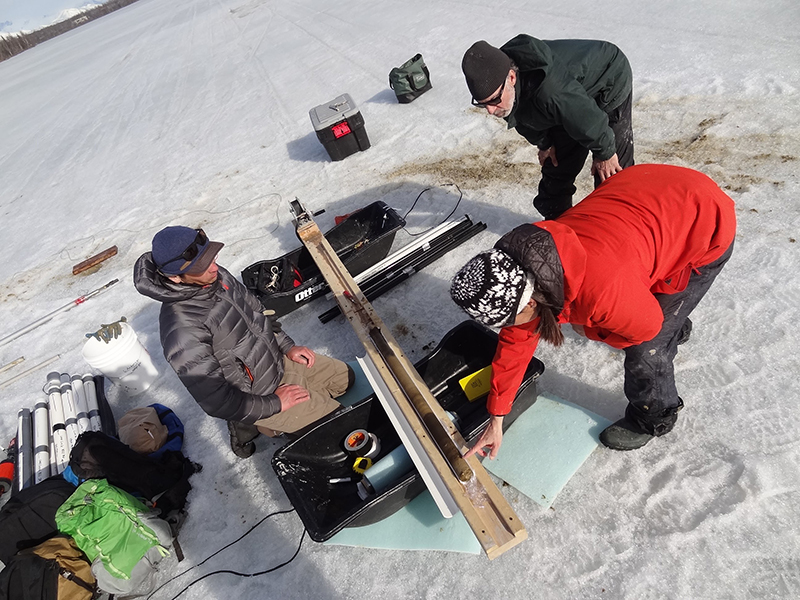
To connect the dots between what was happening in the Atlantic and the Pacific, the researchers obtained and analyzed sediment cores from three Alaskan lakes, April Fools Lake, Neklason Lake, and Finger Lake, and compared them to ice cores from Greenland.
“The cores continuously record information about the environment as they pile up at the bottom of lakes or in snow that turns to ice in glaciers,” Finney said. “These lakes are important because they are adjacent to the North Pacific Ocean, and sensitive to changes in that region which impact climate over a large part of North America.”
Through the cores, the group sought to determine what was happening in the North Pacific Region at that time. By comparing the ratio of oxygen isotopes in both sets of cores, the team found that they decreased at about the same time, suggesting that Atlantic Ocean currents around Greenland drove shifts in Alaska's climate centuries ago.
“Because previous strong evidence for this event in this region was lacking, we did not expect to see it,” said Finney. “We determined that the climate cooling was mainly in winter, which explains why most records in Alaska hadn’t found it, as they studied things like pollen, which don’t tell us much about winter.”“Comparing the different climate proxies and their distinct expressions of climatic events was intriguing,” said Brad Baxter, who earned his master’s at Idaho State in 2022 and now serves as Research Physical Scientist at the US Army Corps of Engineers’ Cold Regions Research and Engineering Laboratory in Fairbanks, Alaska. “From understanding what aspects of climate the lake isotopes represent, to correlating their variability with other paleorecords. It gave us multiple perspectives on the story.”
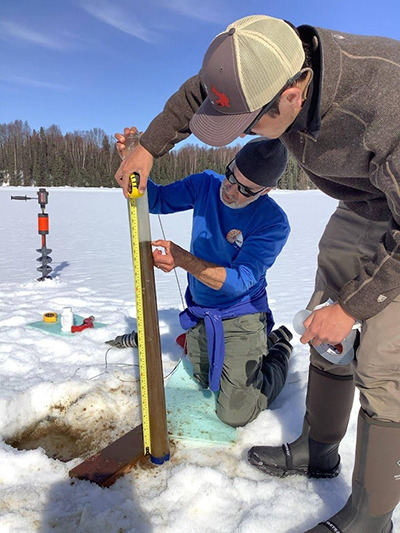
Today, the research team is analyzing cores from other Alaskan lakes to verify their results.
“There are frequent news stories these days concerned about how changes in Atlantic Ocean currents will affect future climates,” Finney said. “The new data from Alaska gives insight into how such changes might affect the other side of the globe, including Idaho.”
“As a student, it wasn't hard for me to find motivation to work on this project,” said Baxter. “I got to work with a fun, insightful, and supportive research team on some exciting datasets. Also, any chance to do fieldwork in Alaska was a major perk for me.”
For more information on ISU’s Departments of Biological Sciences and Geosciences, visit isu.edu/biology and isu.edu/geosciences.
(Photo credits: Carson Baughman and Lesleigh Anderson, courtesy of the U.S. Geological Survey)
Categories: