
Researchers Exploring New Approach to Addressing Idaho’s Water and Energy Needs
January 13, 2026
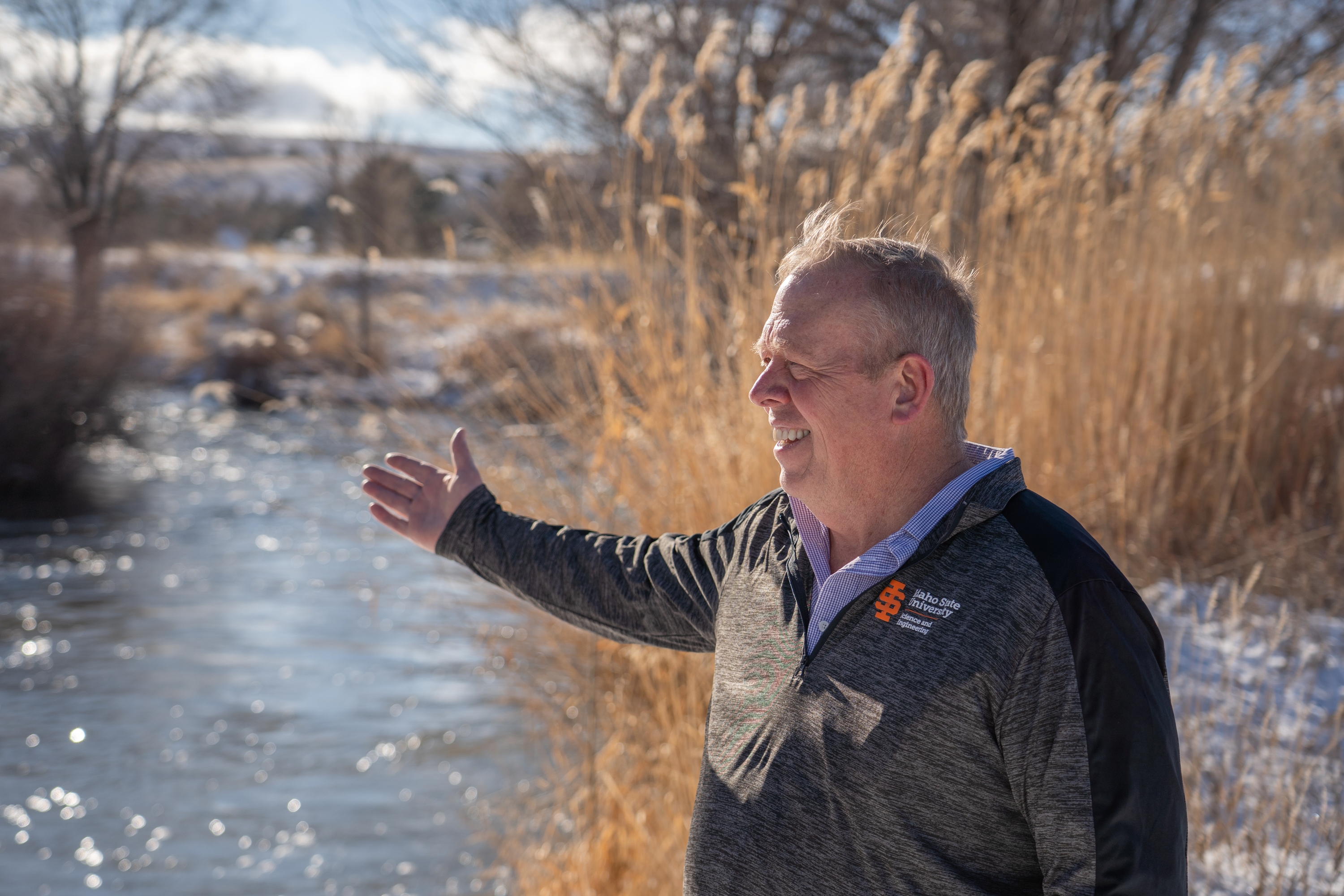
With the Gem State’s population projected to top more than 2.3 million by 2034, a team of researchers is looking into a new-to-Idaho way to address a portion of the state's water and energy needs in the coming years.
“The majority of Idaho’s water comes from snowmelt either via surface water or groundwater,” said Bruce Savage, professor and chair of the Department of Civil and Environmental Engineering at Idaho State University. “Consequently, there is a need to wisely manage our water and find ways to increase our water storage, keeping more of our spring run-off for summer use. This need for additional storage is crucial in a state that ranks third in the nation for total water use and second for irrigation withdrawals.”
Savage, along with James Mahar, senior lecturer in the Department of Civil and Environmental Engineering, have been exploring options for water storage. With Idaho heavily invested in aquifer recharge, especially in the Snake River Plains Aquifer, Savage and Mahar have assembled a team of researchers from ISU and Boise State University to investigate an interesting approach: storing excess runoff underground using subsurface dams placed in high mountain aquifers.
A subsurface dam is an underground barrier built across the natural direction of groundwater flow to store the water, much like placing a small dam in a stream, but entirely below the surface. Like their above-ground counterparts, the subsurface dams would allow the capture of snowmelt that would otherwise be unutilized. The water can then be released in the summer, via the natural river system, increasing stream flows for fish, and providing water for agricultural and municipal purposes.
“Subsurface dams have their own unique advantages: water isn’t lost to evaporation, the land above the water remains usable, and the water is less exposed to contaminants,” said Savage, principal investigator on the project. “Plus, the high mountain subsurface dam can be set up to generate hydroelectric power using the elevation difference.”
While the concept is relatively untested, Savage notes Idaho’s landscape presents a natural fit for subsurface dams.
“Idaho’s steep mountain basins with their permeable glacial and alluvial soils make several regions strong candidates for subsurface dam exploration,” explained Savage. “By capturing excess water during periods of high spring flow, these systems could increase aquifer volume and create natural underground storage that is both geographically shielded and climate-resilient, and be an opportunity to store clean, cold water underground without the environmental and social impacts of large new surface reservoirs. Additionally, using Idaho’s natural river systems for delivery would reduce the need to build new infrastructure like canals to get the water to users.”
Over the next two years, the ISU/BSU research team is tackling how subsurface dams can increase water resilience, enhance summer stream flows, support Idaho agriculture, and provide hydropower opportunities with minimal environmental impacts. Working on the project with Savage and Mahar are ISU researchers Donna Delparte, professor of geosciences; Morey Burham, associate professor of Sociology; research staff Jared Cantrell and Mel Campbell; and student researcher Prajwol Thapa. BSU researchers include civil engineering professors Bhaskar Chittoori and Nick Hudyma, and student researcher Shreya Thul.
“With this research team, we’re getting a good start on the engineering feasibility, potential site characteristics, groundwater impacts, ecological implications, and social perceptions associated with subsurface dams,” Mahar said.
The analysis of subsurface dams is part of the statewide Idaho Community-engaged Resilience for Energy-Water Systems (I-CREWS) collaborative research project. Funded through the National Science Foundation’s Established Program to Stimulate Competitive Research (EPSCoR), I-CREWS “aims to address the consequences of meteorological, population, and technological change on energy-water (E-W) systems.”
“I-CREWS support allows researchers to innovate in ways that directly benefit Idaho,” said Kitty Griswold, the lead ISU EPSCoR faculty for the I-CREWS. “Professors Savage and Mahar built a highly capable team at both ISU and BSU that spans engineering, geoscience, and social science, ensuring that the technical, environmental, and community dimensions of subsurface dams are all evaluated together.”
“While subsurface dams, if proven viable, will not solve Idaho’s water challenges on their own, they offer another tool; an opportunity to store clean water underground without disrupting river systems or significantly altering the landscape,” said Savage. “Our goal is to understand when and where this tool can support Idaho’s long-term water and energy needs.”
For more information on Idaho State University’s Department of Civil and Environmental Engineering, visit isu.edu/cee.
Categories: