
Chile Out: Idaho State University Geologists Investigating Origins of the Andes
April 9, 2026
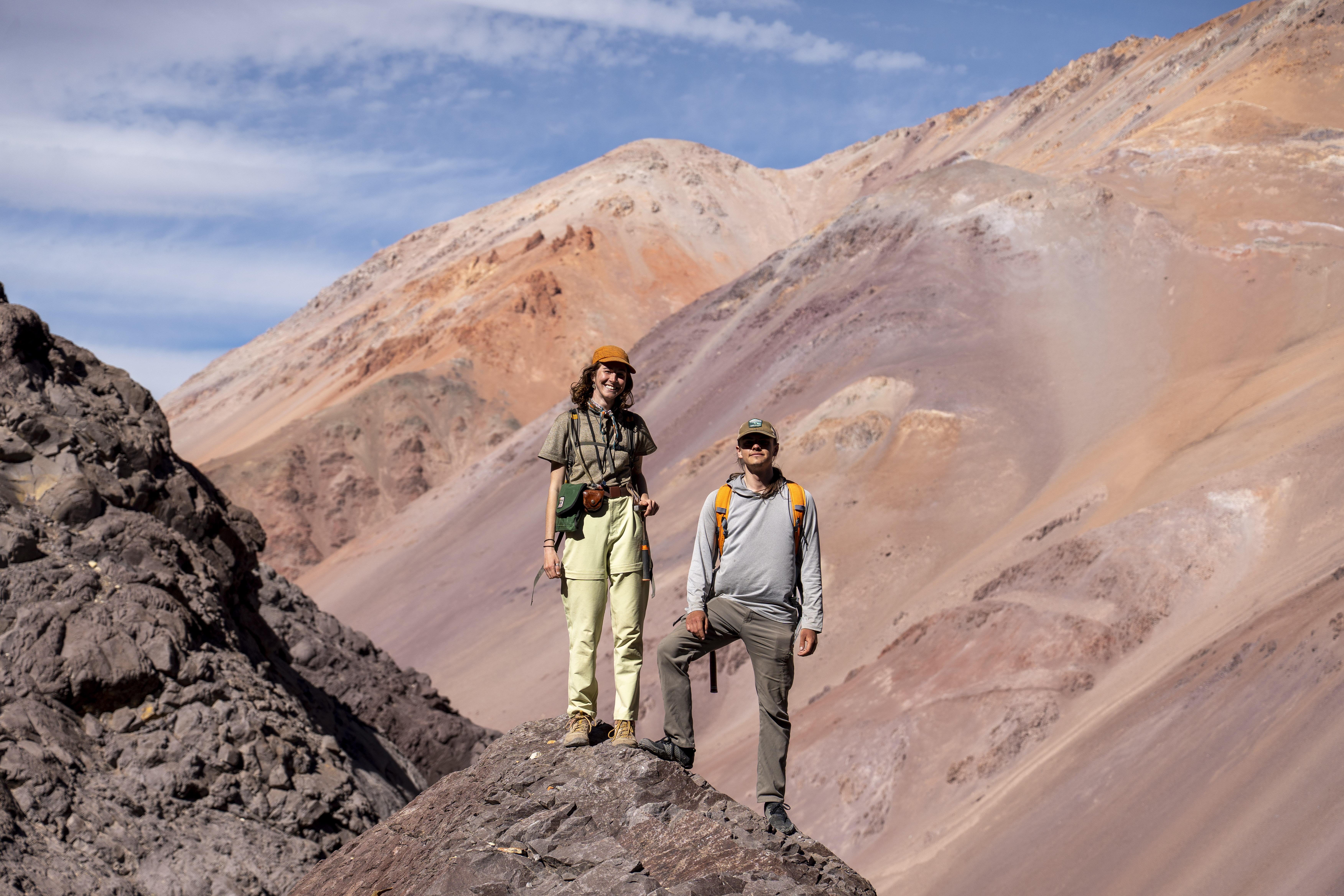
If you want to find out if a continent-sized car crash happened 100 million years ago, you’re going to have to go to the scene of the suspected wreck. For two Idaho State University undergrads, their investigation was the trip of a lifetime to the Chilean Andes.
Geology majors Tiana Hursh and Parker Hazelbush hail from Brule, Wisconsin, and Blackfoot, Idaho, respectively.
“I ended up in Montana for a while and was taking online classes, and took a geology class and was kind of interested,” said Hursh. “I also had an internship for a septic design company, and everybody there had degrees in geology, and I was like, ‘This is really cool.’ I got in-state tuition at ISU, so I’m here.”
“I wanted to go to medical school for a really long time, so I went to another university and did some pre-med stuff and kind of hated it,” Hazelbush said. “I transferred here, not knowing what I wanted to do or what I wanted to study at all. Eventually, I took the intro paleontology class, Real Monsters, from Dr. Leif Tapanila, and I realized geology is what I’ve always actually enjoyed.”
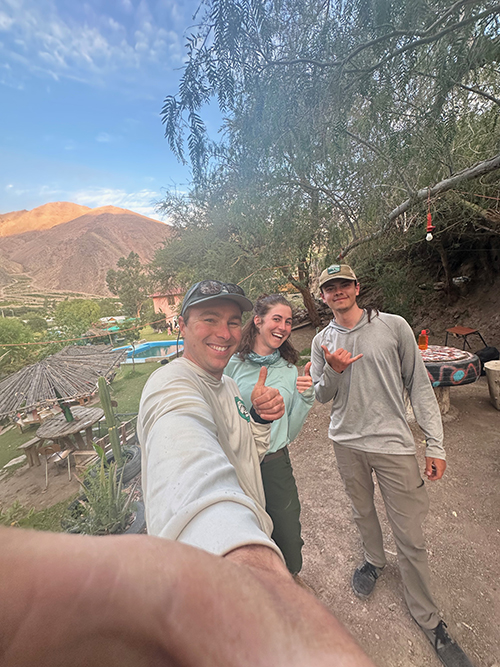
Meanwhile, Chance Ronemus, a National Science Foundation postdoctoral fellow at ISU, and the reason they ended up on the western edge of South America, made his way to Idaho State via Tucson, Arizona. Ronemus is in Pocatello thanks to the NSF fellowship he was awarded, which was put together with the help of ISU faculty members Kurt Sundell and Dave Pearson.
“The Andes of South America are a classic example of how mountains are built along continental margins,” Ronemus details in the NSF abstract for the fellowship. “For decades, scientists have believed that this range formed through a relatively steady, long-term process of oceanic tectonic plates sliding beneath the western edge of South America. However, recent imagery of Earth’s deep interior challenges this view, suggesting instead that a chain of volcanic islands—perhaps resembling modern Japan—may have crashed into and merged with South America about 100 million years ago.”
So why worry about how the world’s longest mountain chain–if you stretched the Andes across North America, they’d stretch from Miami to the northwest corner of Alaska–got its start?
“Answering this fundamental question will improve our understanding of how continents grow, how Earth’s crust is recycled back into the mantle, and how and where valuable mineral resources are formed,” said Ronemus. “I was going to go do the same project at Stanford using department money, but I was like, ‘Well, I think I would rather live in Pocatello and get experience working with students at a state university and involve undergrads.”
As he settled into ISU and the Gate City over the course of Fall 2025, Ronemus set out to recruit students for the project and issued an email call. That’s when he got connected with Hursh and Hazelbush.
“I wanted to get into research ever since I got into my degree,” said Hazelbush. “I wasn’t sure where to look for it or how to reach out to professors about anything, but I saw the email and I just, on a whim, applied to it.”
“I wanted to do undergrad research, but didn't know how to seek it out or anything,” Hursh said. “Here, advisors and people are very good at trying to create opportunities for undergrad researchers to get involved. When Chance sent out the email, I not only just emailed back, but went up, and I was like, ‘Hi, I'm interested, this is a great opportunity.’”
Like most fields under the STEM umbrella, geosciences is a hands-on discipline. Geologists often need to put eyes on the different rock layers, take measurements, and collect samples. Consequently, if you’re a researcher looking to study mountains in Chile, well, you have to go to Chile, and Ronemus scheduled a trip over the winter break. Before heading out, the group met weekly to discuss key papers and study the region’s geologic maps. During the lead-up, they also received training on preparing for international fieldwork, what essentials to pack, and insights into local customs.
So in December 2025, Ronemus touched down for a six-week stint in South America. Before heading to Chile to investigate the continental car crash, he went to the Neuquén Basin in Argentina to explore a puzzle that’s more recent in geologic time. With Lucas Fennell from the University of Buenos Aires, a fellow geologist Ronemus met when he was on a Fulbright Research Scholarship in Argentina in 2024, he road-tripped from Patagonia to Mendoza, hunting for exposures of rock known as Rodados Lustrosos. In English, it means “shiny cobbles,” and Ronemus and Fennell believe the rocks are a fossilized “desert pavement” that formed between 20 and 40 million years ago.
“These features are rare in the geologic record and are a record of very arid conditions and a unique plate tectonic configuration, with implications for how South America’s hydroclimate evolved,” Ronemus said.
Three weeks later, Hursh and Hazelbush landed in Santiago, Chile, for a three-week stay of their own. They met up with Ronemus and set up camp–literally–on a beach near the coastal hamlet of Los Molles.
“We were camping right off the beach where our formation that we were studying was, so we were able to just wake up and go right to the field site, right out the tent door, essentially,” said Hursh.
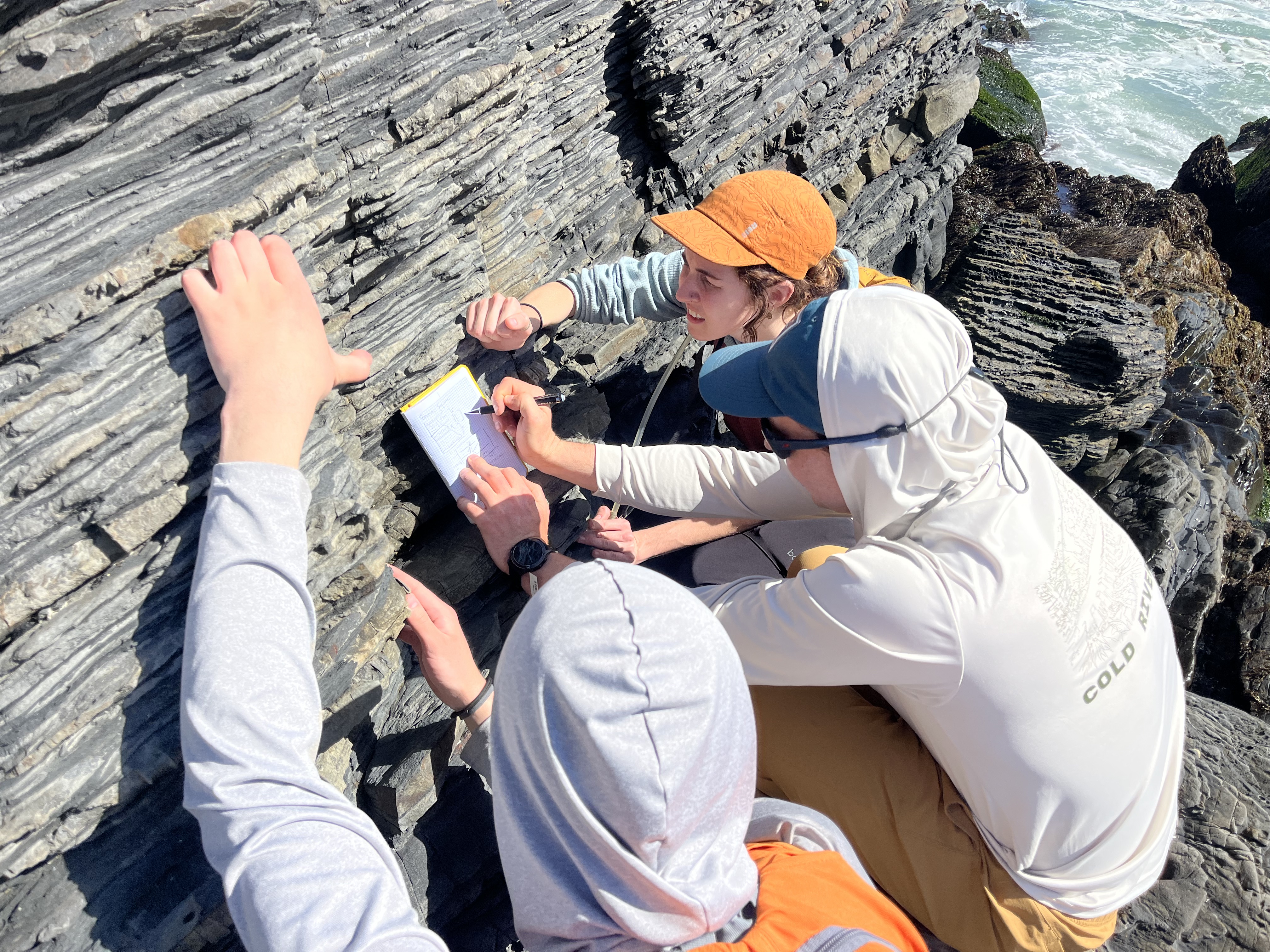
At the field sites, the trio–along with their collaborators, María Pía Rodríguez from Andrés Bello University, Ismael Murillo with the Servicio Nacional de Geología y Minería, and Stephan Graham and Stephen Dobbs from Stanford University, and Idaho State Assistant Professor Kurt Sundell, who joined in mid-trip–looked to examine and collect samples of a specific type of rock: turbidites. These are sedimentary rocks formed by underwater avalanches of mud, silt, or sand. The rocks self-sort to some extent, with the largest and heaviest sediments at the bottom, and the finer and lighter ones towards the top.
“Being able to see the turbidites was really cool,” Hursh said. “I’ve written research papers about turbidity currents and turbidites, so theoretically knowing what they look like in my brain, and actually being able to see what it looks like, and also going through a formation and seeing how it changes depositionally from shallow to deep marine. It was very cool to not be reading a textbook, but seeing it, and seeing textbook examples.”
“I've never seen a lot of the depositional environments that we were actually looking at, like the turbidites themselves,” said Hazelbush. “We don’t have turbidites like that (in Idaho).”
They also had the chance to see a relative rarity in the world of geology: hummocky cross-strata. Like turbites, they’re formed underwater, at the spot where sediments are churned up by the day-to-day action of the waves, and those that are jostled when a storm rolls through meet.
“Hummocky cross-strata are cool because they only occur when you're in a setting between the fair weather wave base and the storm weather wave base. So, they're kind of a rare sedimentary feature,” Ronemus said.
After a little less than two weeks on the coast, the group took a weeklong road trip and headed deep into the Andes to the Principal Cordillera with their Chilean collaborators.
“Based on the rocks we saw, our ideas sort of started to evolve, and we became interested in comparing rocks along the coast to those exposed up in the high Andes,” said Ronemus.
Like their work on the coast, the group collected samples and took measurements before heading back down to the Pacific coast near where they had started their trip. Over the course of their three weeks in-country, the trio also had the chance to take in a bit of daily life in Chile.
“The guanacos are cool,” Hursh said, “sort of, like, alpaca-llama animal native to South America that scream-giggle for noises, and it's kind of terrifying.”
“So many opportunities to get out and see all the nature there, experience the culture, food, everything like that. It was a really good experience,” said Hazelbush. “A big thing for me, wherever I go, is always the food. I really enjoyed the empanadas down there.”
However, the language barrier did lead to one gastronomical blunder at a restaurant.
“Not knowing Spanish, I accidentally ordered a sea snail empanada, so I got to experience that,” Hursh said. “I ate half of it before I became too aware of the texture and the saltiness of it, and I was like, ‘I can't do it anymore.’”
“It was on the menu as Loco Queso, and Tiana's like, ‘Oh, I know those Spanish words, like, crazy cheese, and it must have a lot of cheese.’ And it turned out to be sea snail and cheese,” Ronemus said.
Now back in Pocatello, Ronemus, Hazelbush, and Hursh have handed off the project to two other students, Amarissa Cramer and William Crater. They’re responsible for crushing the samples from the Chilean Andes to the point where they can get down to the mineral zircon. These tough-as-nails minerals stick around through all sorts of conditions and contain a little bit of uranium. It’s that trace bit of uranium that allows geologists to know how old they are.
“So the Japan-type island archipelago colliding with South America, if that were correct, then these sedimentary rocks that are preserved in western Chile shouldn't have any (old zircon) material that was sourced from South America,” explains Ronemus. “Whereas if those sedimentary rocks were actually deposited on the western part of South America, and no terrain collision occurred, then we should find older ages.”
"What I find interesting about this project is the investigative aspect of the project, as we use zircon ages to piece together the history,” Cramer said. “I also enjoy practicing zircon geochronology, especially with the guidance from Chance."
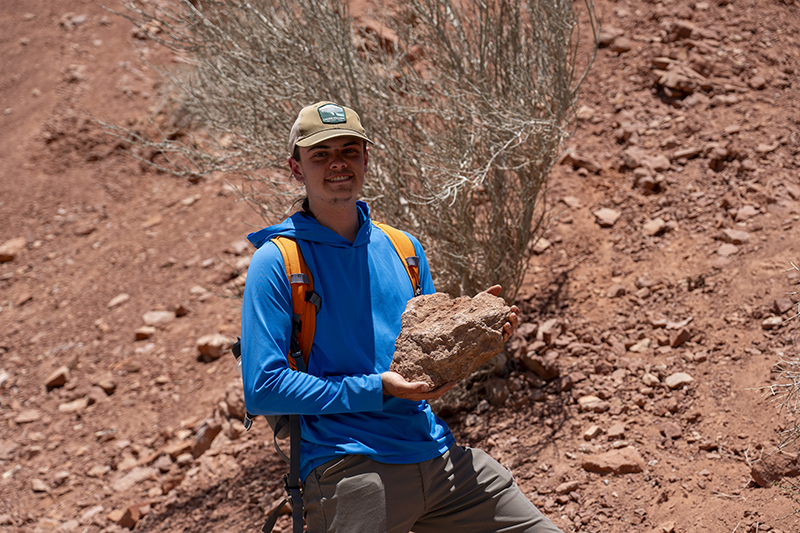
“Getting to do this firsthand and to do my own presentation on it to my class is a very cool opportunity I've been granted," said Crater. "My experience with research is very limited, as I'm only in my second semester here, so it makes me excited to continue to do more research as I keep going to school here."
The group recently presented two posters showcasing their preliminary results at the ISU Research and Creative Works Symposium in March. Looking ahead, they plan to share their findings with the broader research community at the Geological Society of America’s Connects Conference in Denver this fall and co-author a scientific journal article.
“I think our preliminary results aren't looking too favorable for the collision model, but there's still some odd things that are going on,” Ronemus said. “Our kind of leading theory that we're trying to test now is not so much whether like an island archipelago collided with the margin, but more so, whether the margin transitioned to (a strike-slip margin) like the San Andreas Fault in California for a time. The theory we're more focused on testing now is whether a similar thing might have happened in Chile around 200 million years ago.”
To view a photo gallery from their trip, click here.
For more information on ISU’s Department of Geosciences, visit isu.edu/geosciences.
Categories: