
ROAR Together: Building Idaho’s Future with Rural Communities - Challis
.jpg)
Lani Rambelski, Superintendent and Senior/Junior High School Principal (left) speaks with Angela Sugden, Guidance Counsellor at Challis Senior High School (right).
Jason Kindree and Md Masud Un Nabi
November 11, 2025
ISU’s INCLUDE project is helping rural Idaho schools like Challis Jr.–Sr. High strengthen student success through community collaboration and educational support.
Introduction
The East Idaho region features outstanding school districts and some of the finest educators that you will find anywhere. In June 2025, we had the opportunity to meet with representatives from five of these school districts. We discussed their vision and their success in helping students excel and to reach their professional and educational goals. What stood out was the intense effort to help students in all areas of their lives. While the approach, programs and specific needs of each school may differ from one to the next, timeless principles never change. As we listened to these individuals tell their stories, we could sense the drive and the deep commitment to ensure that every student was provided with the best opportunities and resources available to reach their full potential.
Another recurring theme was the relationship between these schools and Idaho State University, as it is often the main destination for graduates who are a good fit for ISU programs and who wish to study in close proximity to their home communities. All of the staff that we spoke with emphasized the quality work ethic that their graduates learn and rely upon in these rural settings. Perseverance is a prerequisite for many students who are often first-generation college students, but who receive support and guidance from individuals like the ones we encounter in this series of articles. The staff and students at these schools are a source of pride and inspiration, and we cannot thank them enough for their generosity and authenticity as they told their stories. We wish them well as they continue their journey with their students together.
ROAR Together: Building Idaho’s Future with Rural Communities
Challis
By Jason Kindree and Md Masud Un Nabi
Challis Jr. Sr. High School: Resilience, Roots, and a Vision for the Future
In the heart of Idaho’s Round Valley sits Challis Jr. Sr. High School, a cornerstone of the Challis School District #181 and the wider community it serves. For Superintendent and Principal Mrs. Lani Rembelski, the school is more than just a place of learning, it is home. Born and raised in Challis, Rembelski returned in 2006 with her husband, Steve, so their three children could grow up surrounded by family and community. “Family and this small community are very important to me,” she says, reflecting on her journey through education that began as a classroom teacher and led her to the district’s highest leadership role.
With more than two decades in public education and advanced degrees in educational leadership, Rembelski brings deep experience and an unwavering commitment to the students of Challis. Her leadership is rooted in connection. “I know every kid,” she says. “Every kid who comes through the door in the morning I greet them, I know most of their families.”
In a region where more than 70% of the land is government-owned and only 3% of the tax base is taxable, sustaining educational excellence requires community-wide commitment. And Challis delivers. Through strong local support, the district has passed levies that enable critical programs and initiatives. As Rembelski puts it, “Our kids come to school with a strong work ethic,” a reflection of the values held by families whose livelihoods are often tied to mining, agriculture, or public land services.
One of those instilling these values is Angela Sugden, the school’s guidance and career counselor. Originally from Howe, Idaho, Sugden brings a deep understanding of rural student needs. Her passion is helping students feel seen, supported, and prepared for life after graduation. “For me as a counselor, the main thing is we want our kids to feel loved, accepted, and cared about. The test comes after that,” she explains. From organizing career days to personally guiding students through scholarship applications, Sugden makes sure every student understands their options, whether that’s college, technical training, or direct entry into the workforce.
The school’s programs reflect this dual focus on tradition and forward-thinking. Agriculture and welding courses, career technical education, and family science are seen not as alternatives to college but as college, and a pathway to meaningful, self-sufficient lives. “We don’t equate these programs as less,” Rembelski emphasizes. “Our aim is productive citizens: providing for yourself and your families.” One initiative that fosters patriotism at Challis is the Constitutional Challenge, where they take a test consisting of 100 questions, and then have their names placed on a school plaque prominently displayed in the front foyer if they answer the majority of them correctly. This instills a deeper sense of identity and appreciation for one’s nation, a feeling of historical connection.
Caption: Lani Rambelski, Superintendent and Senior/Junior High School Principal (left) speaks with Angela Sugden, Guidance Counsellor at Challis Senior High School (right). They epitomize professionalism and compassion as they work together with students from the Challis School District.
This practical, values-driven approach is evident in the academic achievement diploma developed by the district, a distinction recognizing students who take challenging courses, dual credits, and extra core classes not just for GPA, but for rigor. “We were one of the first small districts to do that,” says Sugden. “It’s not about getting all A’s in easy classes. It’s about pushing yourself.”
And students are rising to the challenge. One student used welding skills gained in the school’s Ag Shop to earn advanced placement in a technical program in Salt Lake City, UT. Others have worked on wildlife conservation projects in partnership with the Forest Service and BLM. The Ag program is a point of pride for the school and for the community. “It’s part of our identity,” says Sugden. Whether it’s constructing bird-safe watering troughs or building senior recognition displays, the program connects classroom learning to real-world impact.
This sense of responsibility extends to the entire student body. Each senior completes a community service project, a tradition that not only benefits local organizations like the golf course and the mine, but also instills the importance of giving back. “They know it’s part of being in our community,” Rembelski explains. This year, students raised money for a beloved teacher battling cancer, an act of compassion that typifies the spirit of Challis.
That spirit is visible beyond the classroom. Parents and families are deeply involved through sports, music, FFA, and school events. The town’s support for education is evident in the stories shared by Shelley Ridenour, general manager and editor of the Challis Messenger, who notes that “it’s hard to find someone in Challis who doesn’t have some role at the school.” From local families donating time and materials to build the baseball field to veterans being honored in an annual student-led K–12 assembly, the community-school relationship is one of mutual respect and pride.
.jpg)
Caption: Viking Pride means respect, commitment, continual learning, and always remembering the community, the connections, and the achievements that are forged here.
In a town where outdoor recreation, patriotism, and volunteerism shape the social fabric, Challis Jr. Sr. High School is preparing students to explore the world and come back stronger. “We encourage them to go out, get experience, and then return to contribute,” says Sugden. “A lot of kids want to leave, but they come back because they value the safety, the connection, and the opportunity to make a difference here.”
Yet the school does not overlook the challenges rural students face, like limited access to foreign languages, internet gaps, and the need for greater post-secondary exposure. That’s why the school has implemented innovative supports like a reset room staffed by a trained behavior interventionist, and has partnered with local health organizations to provide school-based mental health services. “This is what it means to support the whole child,” says Rembelski.
The school also maintains a meaningful relationship with Idaho State University, particularly through dual credit pathways and educator preparation. Several students from Challis pursue higher education at ISU, seeing it as a natural next step that allows them to stay connected to their rural roots while expanding their opportunities. For Rembelski herself, Idaho State University played a formative role: she earned her Bachelor of Arts in Elementary Education there with a focus on reading and instruction for K–12 learners.
In Challis, education isn’t confined to four walls. It’s built into the town’s rhythms, the music festivals, the welding sparks, the career dreams born in a counselor’s office. And under the leadership of committed educators like Lani Rembelski and Angela Sugden, Challis Jr. Sr. High School is not just preparing students for the next step, it’s shaping citizens who will build the future of their community.
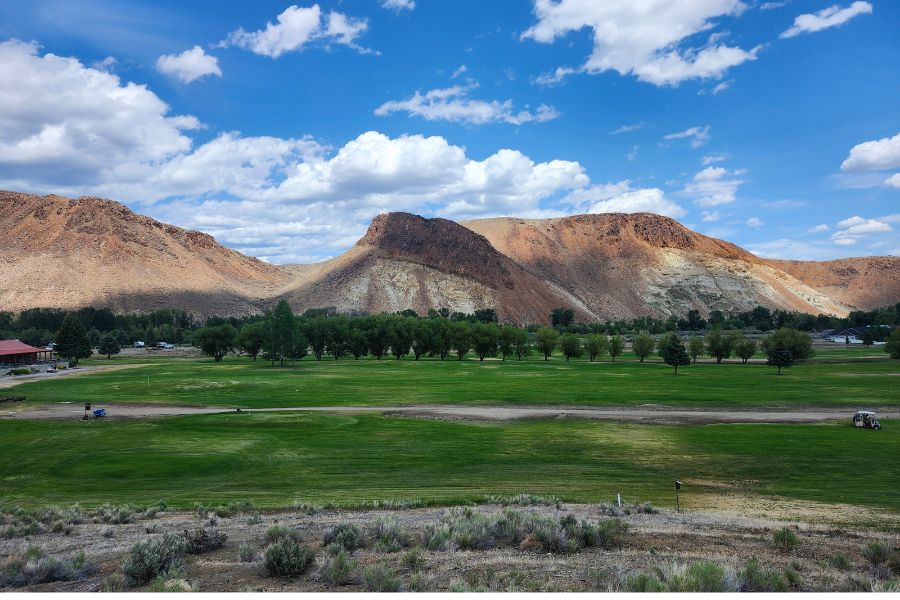
Caption: The scenic view in Challis overlooking the golf course. This rural gem town is both remote and pristine.
About our contributors:
Md Masud Un Nabi “Shuvo” is pursuing a Doctor of Arts in Political Science at ISU. He holds an MA in Communication from ISU and both a Bachelor’s and Master’s in Mass Communication and Journalism from Khulna University, Bangladesh. With a background in journalism, he is passionate about storytelling that amplifies voices, informs communities, and inspires positive change, combining academic insight with practical experience to create meaningful content.
An accomplished English language editor, educator and author, Jason Kindree brings a diverse skill set to any project he is engaged in. He is a Research Fellow in the doctoral program in the Political Science Department at Idaho State University, with a focus on Global Security and US Foreign Policy. Prior to arriving at ISU, Jason spent time overseas in South Korea teaching English as a second language. He returned to the corporate sector as a senior English editor/writer and manager of special projects. He has experience as a business and government consultant, and in developing writing workshops and conceptual frameworks for scientific government agencies and writing business plans and proposals. He is currently working on various research projects and attending academic conferences with the aim of publishing in scholarly journals in his field.