
ISU’s CPI Program Opens Doors in Bingham County
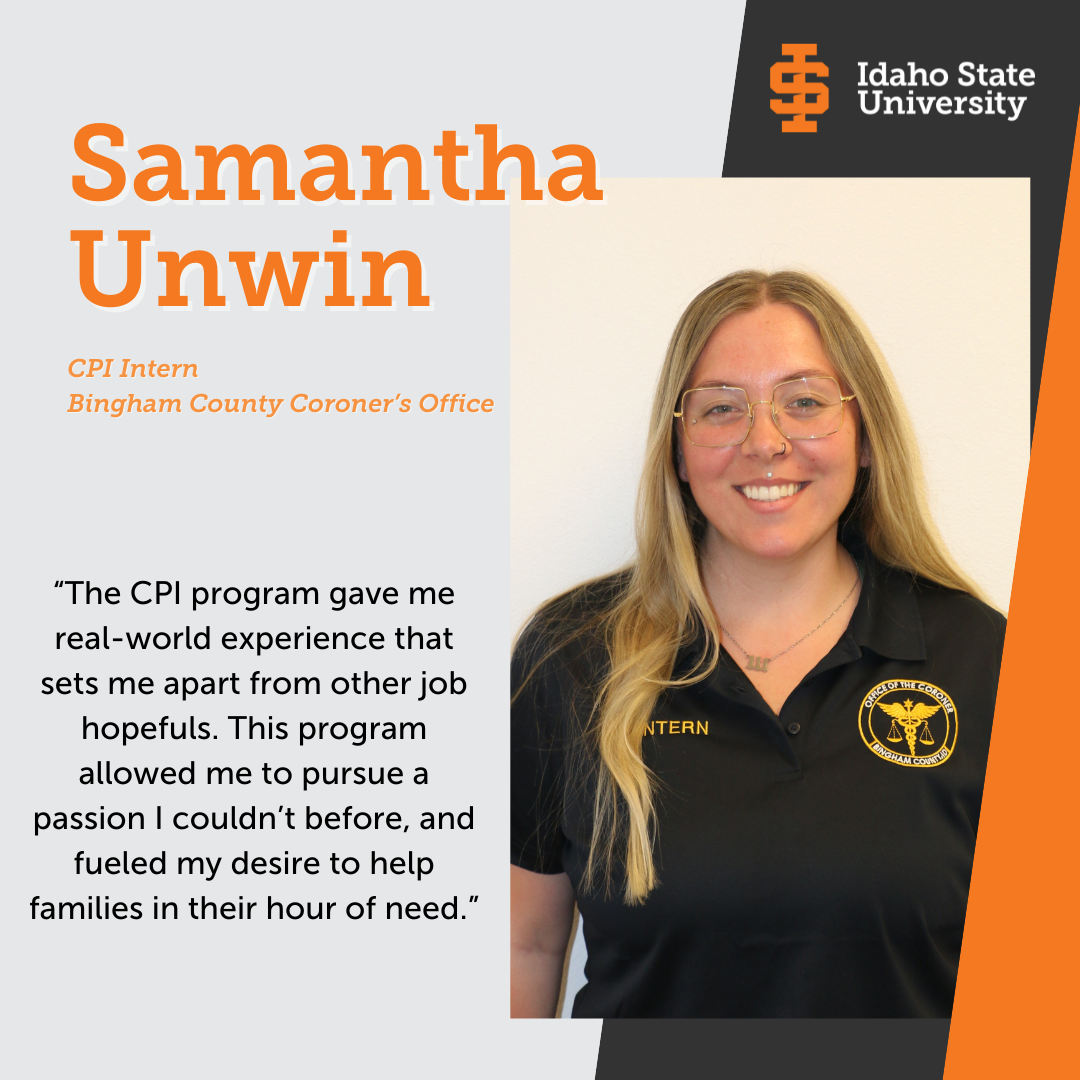
Samantha Unwin
Lydia Maganga, Sadman Sakib, and Elisabeth Curtis
November 30, 2025
ISU’s Career Path Internship program is helping graduate student Samantha Unwin break into the field of death investigation through hands-on work with the Bingham County Coroner’s Office.
POCATELLO, Idaho––For Idaho State University (ISU) graduate student Samantha Unwin, a career in death investigation started with a dream she couldn’t pursue—until now. After earning her bachelor’s degree in California, she worked in funeral services and became fascinated by the work of coroners. But without being a current student, she couldn’t qualify for an internship.
“When I worked at a funeral home, I was affiliated with the coroner’s office in the same county,” Unwin recalled. “I had asked them about doing an internship, but they didn’t offer internships unless you were a student.”
That changed when she enrolled in ISU’s master’s program in biological anthropology and joined the Career Path Internship (CPI) program, a paid initiative that connects students to professional experiences both on and off campus. Through the CPI program, Unwin was placed at the Bingham County Coroner’s Office under Coroner James Roberts, where she began interning in May 2024.
Unwin now balances behind-the-scenes administrative work with hands-on experience in medical-legal death investigations. “You wouldn’t be able to see those types of cases through classes unless there was a non-disclosure agreement,” she said. “I’ve learned so much about statutes and state codes that I never would have thought I would learn.”
Her work includes assisting investigators at death scenes, learning how to preserve evidence, and understanding how coroners communicate with families during their first moments of grief. She also analyzes reports and collaborates on projects with the Idaho Association of Coroners, identifying structural and legislative gaps in the state’s coroners’ association.
“I feel like I have a way better knowledge of using Excel than I did prior,” Unwin joked, “but more importantly, I’ve learned how coroners and investigators interact with law enforcement and families.”
For Roberts, who has two decades of experience as a coroner, the CPI program provides essential support for both students and small county offices. “I am a proponent of offering students a structured career path, as many individuals may lack a clear vision of their future after completion of their studies,” he said. “Such programs are instrumental in transforming aspirations into reality by providing meaningful real-world experiences.”
Since partnering with ISU in 2024, the Bingham County Coroner’s Office has mentored four students through the CPI program. Roberts currently works with two graduate students and an undergraduate CPI who are involved in forensic activities, as well as a returning intern from the previous year.
“This partnership establishes a robust foundation for the students with whom we are collaborating,” Roberts explained. “Even in cases where an intern realizes that a particular field is not suited to them, such an outcome should be regarded as a success, as it prevents them from becoming committed to a career that may not align with their preferences.”
Interns at the office receive in-house orientation and participate in a wide range of activities—from death scene response and autopsies to toxicology and report writing. They also analyze historical case data to identify trends, particularly concerning overdoses, suicides, and tribal deaths, helping the office develop prevention strategies.
“The involvement of critical thinkers who can analyze data and transform it into reusable documents has significantly improved our capacity to respond to medical emergencies in the community,” Roberts said. “This development marks a significant milestone for the organization.”
Unwin’s experience exemplifies the CPI program’s mission: bridging the gap between classroom learning and the workforce through paid, career-relevant internships. For students like her, it’s not just a résumé builder—it’s a gateway to professions that are rarely accessible without prior experience.
“I feel like understanding the processes of death investigations in general puts my foot in the door,” Unwin said. “It can be complicated to get a job if you don’t have the experience for it.”
While small county offices face funding challenges—“They currently don’t have the resources to fund a full-time investigator or a full-time clerical person or secretary,” Unwin noted—partnerships like the CPI program help fill critical gaps.
Roberts hopes that the program continues long-term. “So far, nearly all of the students partnered with us have expressed enjoyment in their experience, and their career aspirations closely align with our organizational objectives,” he said. “I hope this program continues to enhance the skill sets of students before they enter the workforce.”
As the CPI program celebrates its 15th anniversary, stories like Unwin’s illustrate its transformative impact—helping Idaho State University students turn curiosity into confidence, and academic learning into real-world expertise.
About our contributors:
Lydia Kalonde Maganga, from the vibrant, warm heart of Africa – Malawi – is completing her master’s in Communication at ISU, with graduation set for fall 2025. She earned her BA in Business Communication from Malawi University of Business and Applied Sciences. With over five years in journalism, including serving as Information Officer for Malawi’s Ministry of Information, she has seen firsthand the power of information in public service and plans to launch a consultancy focused on branding and public relations.
Sadman Sakib is pursuing a Master’s in Communication, Media, and Persuasion at ISU, where he serves as a Graduate Research Assistant. He earned his Bachelor’s in Mass Communication and Journalism from Khulna University, Bangladesh. His research spans social media, organizational, political, and crisis communication. With multiple national presentations and manuscripts in progress, he explores how communication strategies can shape audiences and connect global perspectives.