
History Professor Completing Prestigious Fellowship
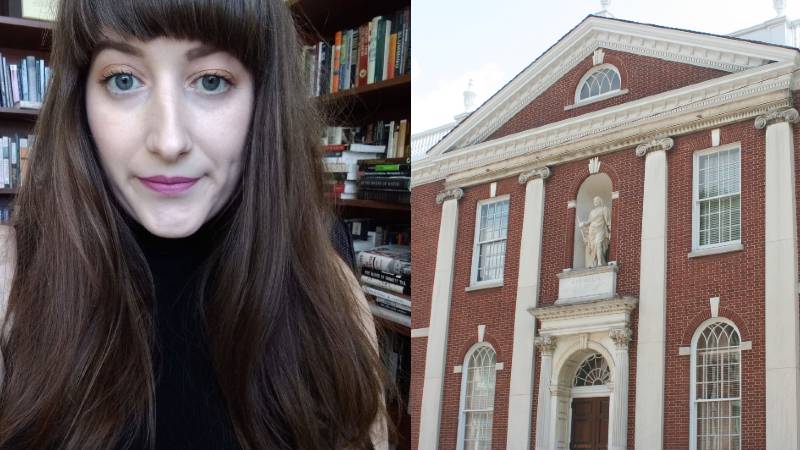
Inside the stately red-brick Library Company of Philadelphia resides one of the most important collections of early American historical artifacts. Thanks to a fellowship from the National Endowment for the Humanities (NEH), history professor Marie Stango is spending the semester studying the books and periodicals inside.
Stango will be in residence at the library from January to April, performing research for and writing her first book, “Afterlives of American Slavery in Liberia.” The book explores the history of the American colonization of Liberia from 1820 to 1860, focusing on gender and family relations in the colonization process.
“This fellowship is a formative part of writing my book,” Stango said. “I can refer to research materials that are one-of-a-kind and generally not available in libraries or archives.”
The NEH awards fellowships to humanities scholars in all disciplines, funding projects that feature exceptional research and a valuable contribution to its field. The organization receives over 1,000 applications and awards an average of only 79 fellowships each year.
As part of the fellowship, Stango has presented a synopsis of her research at the Library Company’s weekly colloquium and attended seminars at other institutions. She resides alongside other fellows, ranging from graduate students to senior scholars, in the Library’s historic Cassatt House.
“This fellowship affords me the opportunity to forge connections with other scholars in Early American studies,” she said. “It is an interdisciplinary space that draws together historians, literary scholars, anthropologists, art historians and others for both formal and informal discussions of our work.”
Stango’s book, “Afterlives of American Slavery in Liberia,” examines the titular country as a microcosm of freedom and unfreedom during the Age of Emancipation. The more than 11,000 African American settlers who sought freedom in 19th-century Liberia, it argues, forged new communities when liberation remained incomplete.
“Often, we think of ‘freedom’ as a binary,” Stango said. “My book argues that instead of seeing manumission as the antithesis of freedom, we see the complex lived realities of the people who participated in this project of colonization, and for whom freedom remained incomplete.”