
New Dino? ISU Paleontologists Homing in on Possible New Species in Wyoming
February 2, 2026
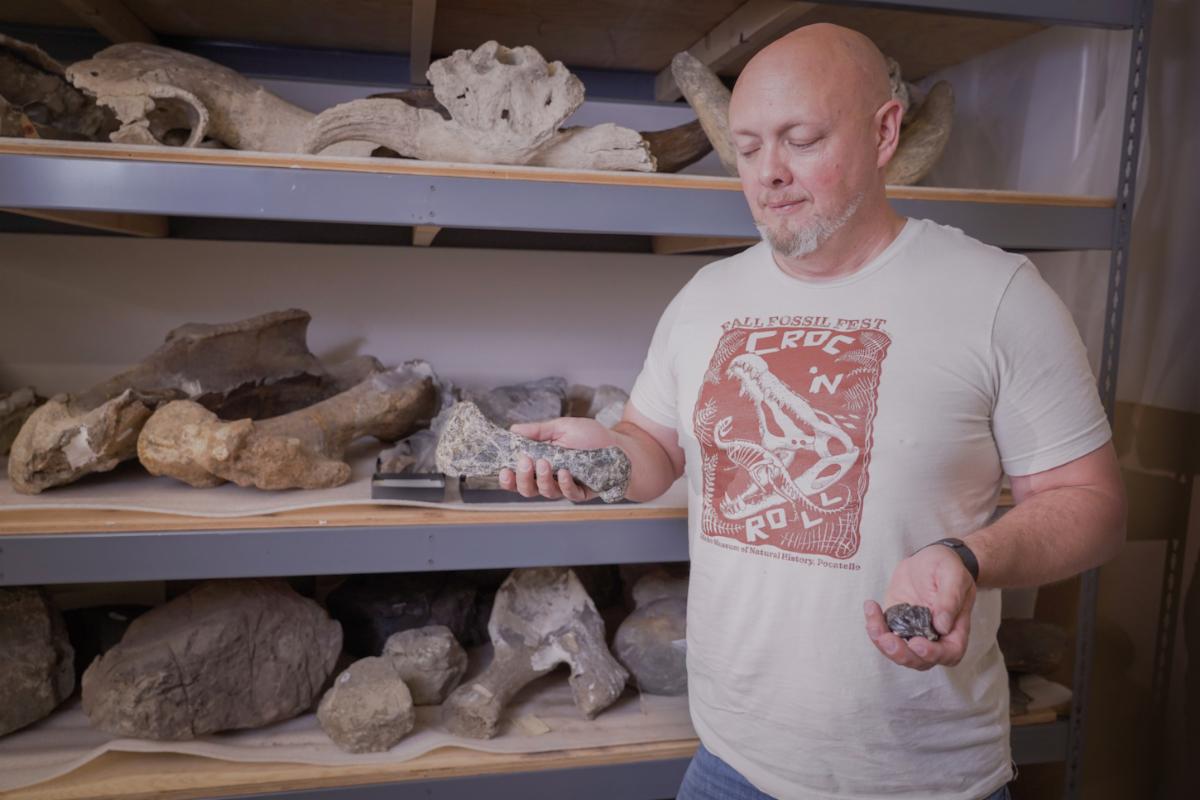
Bones currently separated by thousands of miles could rewrite a piece of the natural history of northern Wyoming.
Detailed in a paper published by the New Mexico Museum of Natural History and Science, L.J. Krumenacker, adjunct professor of geosciences at Idaho State University, affiliate curator at the Idaho Museum of Natural History, and professor of geology and biology at the College of Eastern Idaho, Robert Gay, education manager at the Idaho Museum of Natural History and their co-authors, hypothesize a toe bone and braincase currently in the collections of the Idaho Museum of Natural History, and a skull and skeleton located at the Aathal Dinosaur Museum in Zurich, Switzerland, point to the possibility of there being one or more as yet identified species of dinosaurs that roamed Northern Wyoming 150 million years ago.
“These fossils, from the Red Canyon Ranch Quarry of northern Wyoming, each have distinct features not before described and/or seen in dinosaurs and belonging to a group known as ornithopods, which were large, unarmored plant-eating dinosaurs,” said Krumenacker.
An upper toe bone–called a metatarsal–is longer and skinnier than other known specimens from ornithopod dinosaurs and has a distinct groove on its side, says Krumenacker. Additionally, the braincase has a unique backwards-pointing prong, and the skull, part of a full skeleton affectionately named "Arky," has numerous features and proportions not seen in previously identified species.
“It can be tricky for paleontologists to try and identify a new species,” said Krumenacker. “Since we are relegated to the bones of the dead animal, we need to identify features of the skeleton that suggest a distinct difference in physical characteristics, such as cranial nerve patterns, shape of skull bones, overall proportions of parts of the animal, etc. Additionally, we need to account for the possibility that features may change their characteristics due to the age or gender of the animal.”
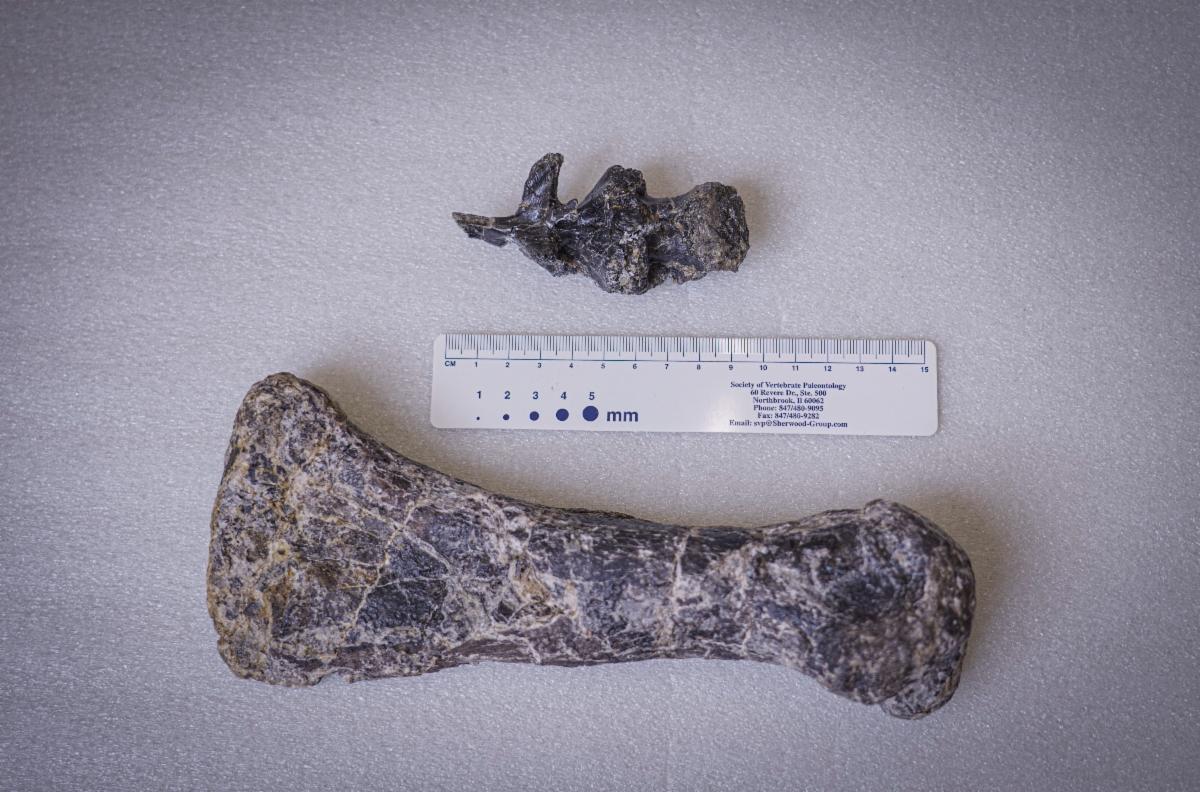
Krumenacker continued, “Skulls and braincases are some of the best elements to help you know if something is new, limb bones and vertebrae not so much. However, our metatarsal is so drastically distinct from anything else that our hypothesis is reasonable. However, being one isolated bone, it is not the best science to try and use it to define a new species. That is why we need to see more skeletons that may have this distinct foot bone and go from there.”
This possibly new animal is similar to the already discovered Dryosaurus and Camptosaurus. These animals may have stood four to six feet tall at the hips and weighed in at 200 lbs. in the case of Dryosaurus, or up to nearly a ton, like Camptosaurus. Walking on two legs, these beaked dinosaurs would have spent their days of the Late Jurassic eating plants.
“During the Late Jurassic, northern Wyoming had a tropical, semi-arid environment with a rainy monsoonal season and a dry season, possibly similar to that of portions of Africa today,” Krumenacker said.
“The smaller plant-eating dinosaurs from this time in North America have confused scientists for nearly 200 years,” said Gay. “Recent work by our colleagues in Europe has helped straighten out our understanding of these animals, which is allowing us to look at the IMNH and Zurich specimens in a new light. Our fossils are frustratingly fragmentary, but they show that there's more to learn about these ‘cows of the Jurassic.’"
Recently, the “Arky” skull and skeleton were donated to the Natural History Museum of the University of Zurich. Once it’s in their collection, Krumenacker plans to return to Zurich to study the skeleton in greater detail and confirm if they’ve found a new species.
“I’ll need to take 3D scans of the bones, document their anatomical features, and take measurements and photographs to compare them to other skeletons of Camptosaurus and Dryosaurus at other museums in the U.S.,” said Krumenacker. “The skull will especially help with determining if this indeed is a new species because these elements have the most variability and distinct features between different species. Arky's skull consists of numerous different original bones, and a smaller portion that are reconstructed. All of these are currently fused together in the reconstructed skull, and we need to remove the reconstructed portions to verify the anatomy of the entire skull as reconstructed. Once this is done, we should be able to compare and contrast with Arky's closest relatives and see if the perceived differences in the reconstructed skull are legitimate.”
Additional co-authors on the paper, Enigmatic ornithopod specimens from the Simon Quarry of the Late Jurassic Morrison Formation, Bighorn Basin, Wyoming, are Joseph Peterson, associate professor at the University of Wisconsin Oshkosh; Rod Sheetz, curator with the Brigham Young University Museum of Paleontology; and Bob Simon, a private paleontologist.
“Hopefully, this study inspires others to look at their Camptosaurus fossils to see whether these features are preserved there too (or not), which will go a long way towards testing our hypothesis on where this animal fits in the tree of life," Gay said.
For more information about the Idaho Museum of Natural History, visit isu.edu/imnh.
More on ISU’s Department of Geosciences can be found at isu.edu/geosciences.
Categories: