
Junior Goes to Washington: IMNH Specimen to Star in Exhibit at the National Museum of Natural History
April 29, 2026
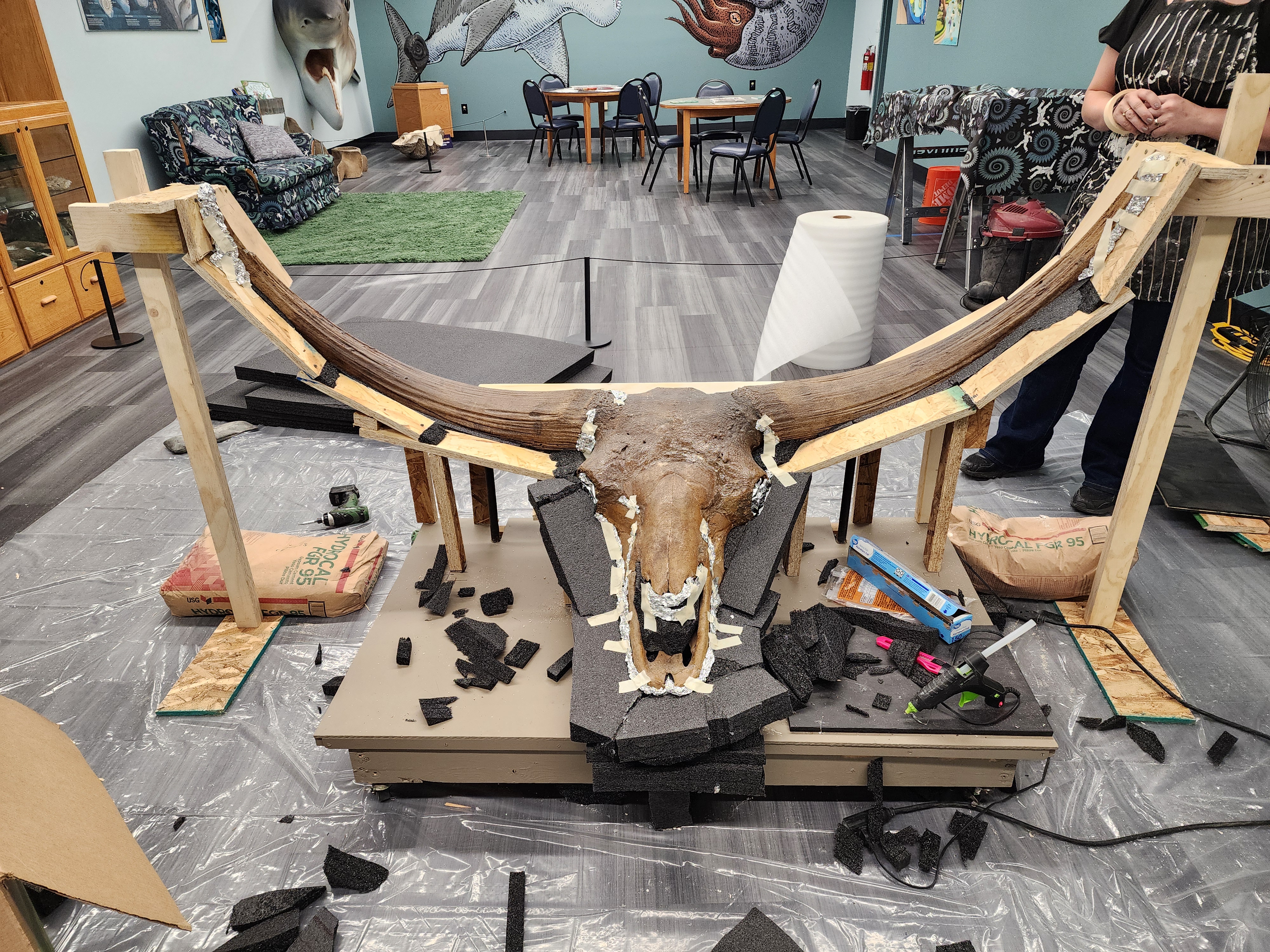
One of the most pristine pieces in the collections of the Idaho Museum of Natural History is heading for the big time.
Recently, Junior, a six-foot-wide skull of a Bison latifrons specimen from the IMNH, was called up to be one of the central features in the National Museum of Natural History’s new exhibit, “Bison: Standing Strong.” Located on the National Mall in Washington D.C. and opening to the public on May 7, “visitors will learn about the rise, fall and resurgence of the national mammal. This epic tale is brought to life through several specimens and objects, including a mounted bull bison and bison-related objects from Indigenous communities.”
“Bison latifrons is an iconic animal from Ice Age North America, and Idaho is fortunate in having many incredibly preserved specimens of this species from American Falls,” said Brandon Peecook, assistant curator of paleobiology at IMNH and an associate professor in ISU’s Department of Biological Sciences. “Junior is easily our most beautiful, so when the Smithsonian called, I knew immediately who had to go to D.C.”
Junior was discovered close to American Falls Reservoir by Marie L. Hopkins in 1948. Hopkins, Idaho’s first female paleontologist, spent decades as a curator at the IMNH in Pocatello and spearheaded digs around East Idaho before retiring in 1966. After the discovery and restoration of Junior, the skull was a focal point of the IMNH for over 70 years before its recent ascent to the big leagues. As a species, Bison latifrons roamed most of North America, looking like a much larger version of a modern-day bison, albeit with Texas longhorn-sized horns, around 100,000 years ago. These Idaho animals were contemporaries of Columbian mammoths, American lions, dire wolves, and giant sloths.
“The rocks that preserved Junior are from the last interglacial period, a time between advancing ice sheets when Idaho would have looked quite familiar, even 'normal,'” Peecook said. “One of the best parts of the American Falls fossil record is that we find specimens not just of Ice Age giants, but of common animals still in Idaho today: cranes, geese, gopher snakes, muskrats, coyotes, frogs, suckers, you name it.”
Junior will stay on the second floor of the National Museum of Natural History until May 2029, then return home to Pocatello.
“It's really great to share a piece of Idaho's history on America's biggest stage for the 250th celebration,” said Leif Tapanila, director of the Idaho Museum of Natural History and professor of geosciences at ISU. We're excited for this opportunity to represent such an iconic American animal.” For more information on Junior’s trip to Washington, D.C., visit this blog post from Smithsonian Magazine.
For more information on the Idaho Museum of Natural History, visit isu.edu/imnh.
Categories: