
Eruptive Art: IMNH to Display ISU Student Works Highlighting Idaho’s Volcanic History
May 4, 2026
The story of the Gem State’s rich volcanic past told through the art of Idaho State University students will be on display at the Idaho Museum of Natural History.
Officially debuting Tuesday, May 5, at 6 p.m. in the Community Gallery of the IMNH, the Small Batch, Artisanal Magma and Major Events: Volcanic History of Idaho will showcase works inspired by the Idaho Batholith and the Challis Volcanic Group in the central part of the state, as well as the volcanoes of the Snake River Plain, Craters of the Moon National Monument and Preserve, and more created by ISU students. The pieces were produced by Bengals in the Volcanic History of Idaho and Artistic Interpretation class, and each work includes a statement explaining the location that inspired it, the artist’s motivation, and the techniques used to create it.
“The IMNH is excited to host the artwork created by these students that has been inspired by our shared natural history across time and place in Idaho,” said Amber Tews, assistant director of public operations and anthropology collections manager at the Idaho Museum of Natural History.
“I'm displaying three paintings and a sketch, and my favorite part of creating the paintings was thinking back to all the fun I had on the trip.’ said Leigh Blom, a geology major. “Each piece is from a different day on the trip. The sketch is from the Mackay Dam for the Challis Volcanics, the small painting is a fun, color version of Mount Borah, one of the larger pieces is Grey's Landing, and the last piece is a close-up of an overturned chunk of the blue dragon flow in Craters of the Moon.”
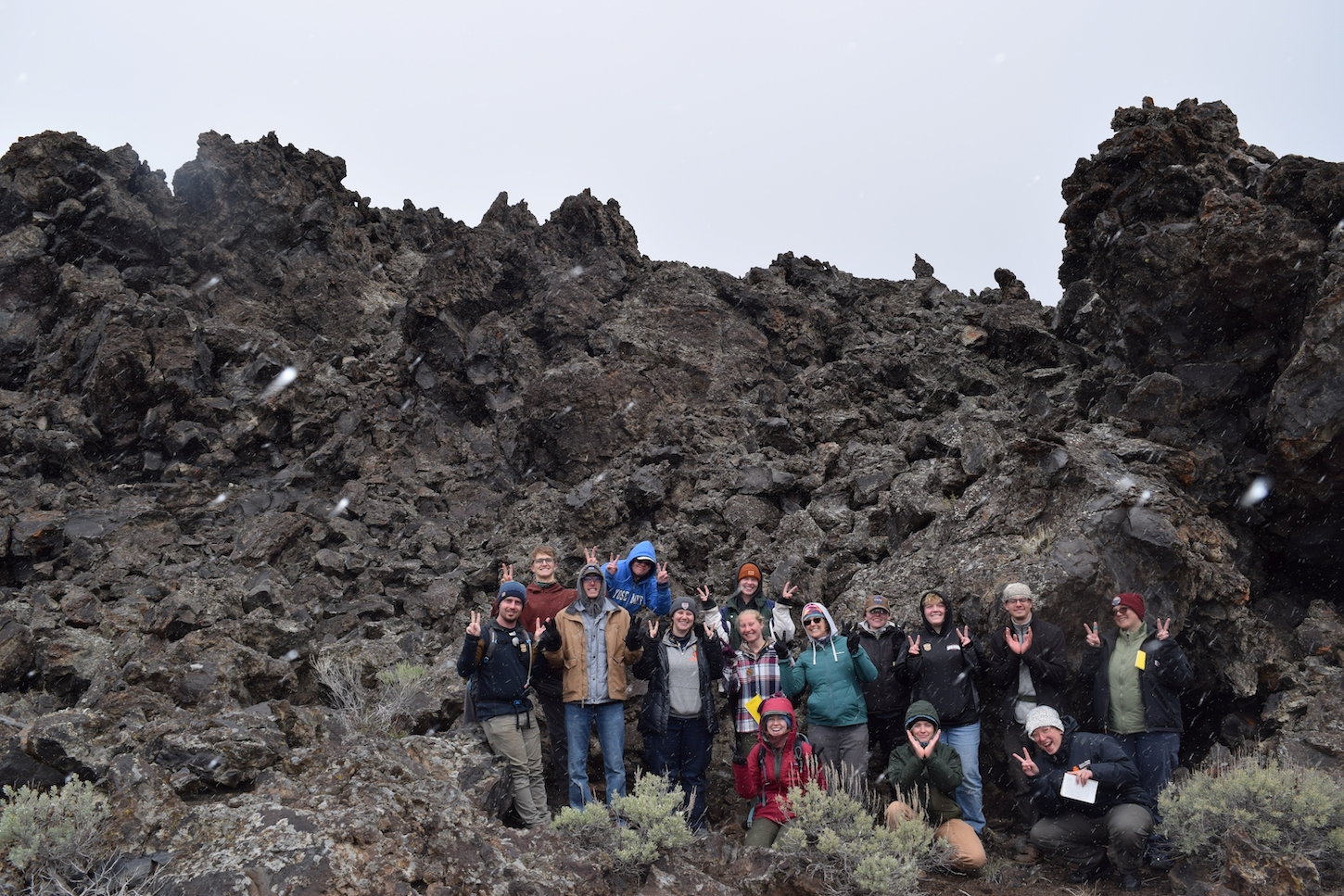
The course, taught by Shannon Kobs Nawotniak, professor and chair of the geosciences department at ISU, and Laura Ahola-Young, professor of art and vice provost for faculty affairs, gave students crash courses in volcanology, basic drawing, volcanic history, and watercolor techniques, among other topics, during the spring semester. In late April, the class took a six-day field trip to see the geologic features they’d been discussing in person and to gain some inspiration for their works.
“Geosciences and art are a great combination because they both rely so heavily on observation,” said Kobs Nawotniak. “You need to take the time to look really closely, and to differentiate between what you really see and how your brain simplifies things or fills in missing information. You don't need to be able to paint a photorealistic landscape to be a great geologist, but you need to be able to read the landscape with an investigative eye.”
“I hope students learned how to use drawing and painting as a way to see,” Ahola-Young said, “ and as a tool to help communicate nuance and record information scientifically and creatively.”
The works will be available for viewing until May 11.
For more information on the Idaho Museum of Natural History, visit isu.edu/imnh.
More on the ISU Departments of Geosciences and Art can be found at isu.edu/geosciences and isu.edu/art, respectively.
Categories: