
Polar Bears, Brown Bears and a Historical Alaskan Mystery
October 12, 2026
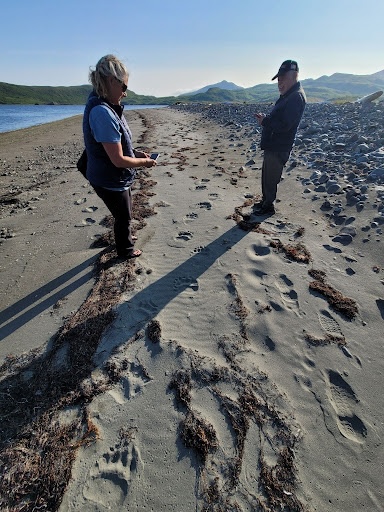
On a little island in the North Pacific, there is a mystery that no one can quite explain—not yet, at least.
The National Science Foundation recently awarded a grant to fund an archaeological project on Unalaska Island, Alaska, spearheaded by Katherine Reedy, interim dean and professor of anthropology at Idaho State University College of Humanities, Education and Social Sciences.
Reedy shared the mystery that she and her team intend to solve: How did brown and polar bears arrive on Unalaska Island thousands of years ago?
“The project examines the finding of brown bear and polar bear remains in archaeological sites on Unalaska Island,” said Reedy. “This is a surprise because this is far outside [the bears’] range today and Unalaska is an ice-free island. The bears appear during two periods, about 5,500 years ago and again about 3,000 years ago, both of which were much colder than today and likely saw sea ice expanding into the islands.”
The project is a joint effort between Courtney Hofman and Lilly Parker of the University of Oklahoma, Catherine West of Boston University, and Reedy.
“We're trying to understand how past climate change affected the environment, animals and the indigenous Unangax̂ (also known as Aleut) people living there,” said Reedy. “These bear remains are the only known archaeological evidence in the Aleutian Islands, except for the farthest eastern island of Unimak. [We will be] looking at ancient DNA, radiocarbon dating and stable isotope analysis to identify what species are present, which populations they are related to, their diet and how people may have interacted with bears.”
When asked about her current hypotheses for how bears got to Unalaska, Reedy was still puzzled.
“Bears can swim, of course, but not the distances required to get to Unalaska,” Reedy explained. “It does appear that sea ice was down in the islands during the Neoglacial and that bears could travel to the islands via the ice. It is not ice you can walk on, though. It is crunchy, not contiguous, and shifts around, and would be tough for a bear to travel easily. They could have been traded in, but the bear remains show butchery marks and were likely processed on the island.”
While the task sounds daunting, Reedy has plenty of experience working in Alaska.
“My first work in Alaska was volunteering on an archaeological project on Unimak Island in 1995 and it was the most wild experience I had ever had,” said Reedy. “We had to fly in a tiny airplane and land on the beach on tundra tires. We set up a camp down in a valley to try to get some protection from strong winds. There were brown bears everywhere, so we had to do firearms training before we could go.”
Reedy explained that bears are a significant part of life on Unimak even today. “They really structure how people move about the landscape, even within the villages,” said Reedy. “Everyone is very cautious about hiking, berry picking, beachcombing, even just walking between houses. There have been some tragedies in the past and many close encounters. There are also stories of hunting bears for food and hides and their roles in ceremonies.”
Reedy also shared her part in the project. “My part of the project is to work with the local tribes to help interpret the archaeological record and the results of the DNA and isotope work. Local knowledge of the environment, climatic events, animal behavior, hunting practices and human-animal encounters and relationships will help to understand how these novel species may have been incorporated as food or tools.”
Reedy’s next steps in the research are to find out more about the local community’s relationship to the environment. “Through interviews, I hope to better understand how people today interact with bears to better understand Unangax̂ culture and community.”
To find out more about ISU’s anthropology program, please visit their information page.
Categories: