Founding Members of the Partnership
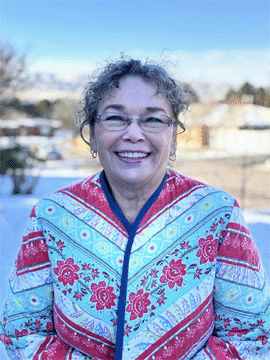
Deb Pein
As a founding member of the Portneuf Pollinator Partnership, Deb is thrilled to promote pollinator conservation. Her lifelong love for nature and the outdoors inspired her to become certified as an Idaho Master Naturalist. She feels privileged to be a member of the Portneuf Pollinator Partnership’s remarkable group of pollinator advocates. Whether it’s surveying milkweed patches, collecting native plant seeds, contributing to community pollinator gardens, or volunteering at the Museum of Natural History Herbarium, Deb is “all in” and enjoys participating in citizen science conservation initiatives and making a difference. With 24 years of teaching experience, she retired as an Assistant Professor at Idaho State University and is a member of High Desert Master Naturalists, the Friends of Edson Fichter Nature Area, Sawabi Idaho Native Plant Society, and Xerces.
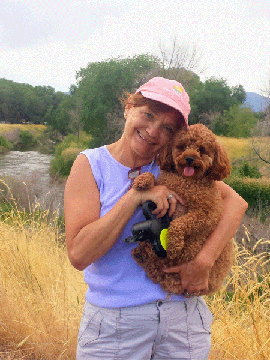
Linda Popelka
Contact: linda2483204@gmail.com
Linda Popelka retired from a 30-year career in Speech Language Pathology. She is now directing her energy into learning about and supporting this wonderful, beautiful ecosystem that surrounds and supports us all. As a Certified Idaho Master Naturalist and a Certified Pollinator Steward, Linda is passionate about introducing youth and adults to the fascinating world of plant-pollinator relationships and helping the public create supportive pollinator habitat in their own yards. She is very grateful to be a founding member of the Portneuf Pollinator Partnership and work with other like-minded enthusiasts who have now become good friends.
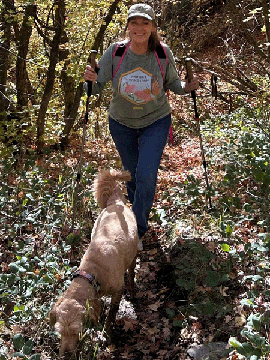
Hannah Clawson
Contact: hannah@sagebrushlandtrust.org
Hannah is from Idaho Falls and has always been passionate about science and art. She attended ISU and graduated in 2024 with her BS in Biology, emphasizing in Ecology and Conservation. She loves drawing, painting, and anything that involves insects. Hannah loves living in Pocatello and enjoys working with others on projects that benefit the community. She is a part of the Master Naturalist program, the PPP, and is the Stewardship Coordinator at Sagebrush Steppe Land Trust (SSLT). Hannah hopes that her scientific illustrations and involvement in the PPP will inspire others to learn more about pollinators and conservation within the community.
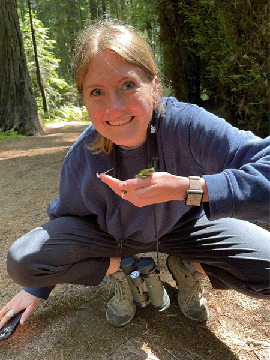
Jessica Fultz
Contact: fultjess@isu.edu
Jessica received her undergraduate training at Montana State University (MSU) - Bozeman in biology and biotechnology and graduate training in entomology. As an entomology M.S. student, she spent three summers in Central Montana at the Tenderfoot Creek Experimental Forest studying insect and plant interactions. After graduating in 2005 she was hired as an insect diagnostician and pesticide applicator program assistant for the Montana State University Extension Service. Since arriving in Pocatello, she has worked for the Department of Biological Sciences at Idaho State University as an instructional laboratory coordinator and senior lecturer.
Gloria Hansen
Contact: glohhrn@gmail.com
I was raised in the remote mountains of Maine. Even as a child, I spent a lot of time enjoying the outdoors, especially the wildflowers. My life moved to Idaho when I went to college. Once I retired after 45 years working as an RN in high stress areas, I wanted to pursue what brought calm and happiness to my soul. I joined the Idaho Master Naturalists which led to a diversity of education of the greater outdoors in our area. I always enjoyed being in the wild, but found my knowledge on wildflowers in Idaho was limited. I also found a fascination with the monarchs and honeybees. I realized the best way to change our world is to work and educate the children. My hope is to educate and show the importance of making an environment that provides growth for our pollinators and our planet, for us and future generations.