
From Byproduct to Breakthrough: ISU’s Sweetcrete Hits the Field
April 27, 2026
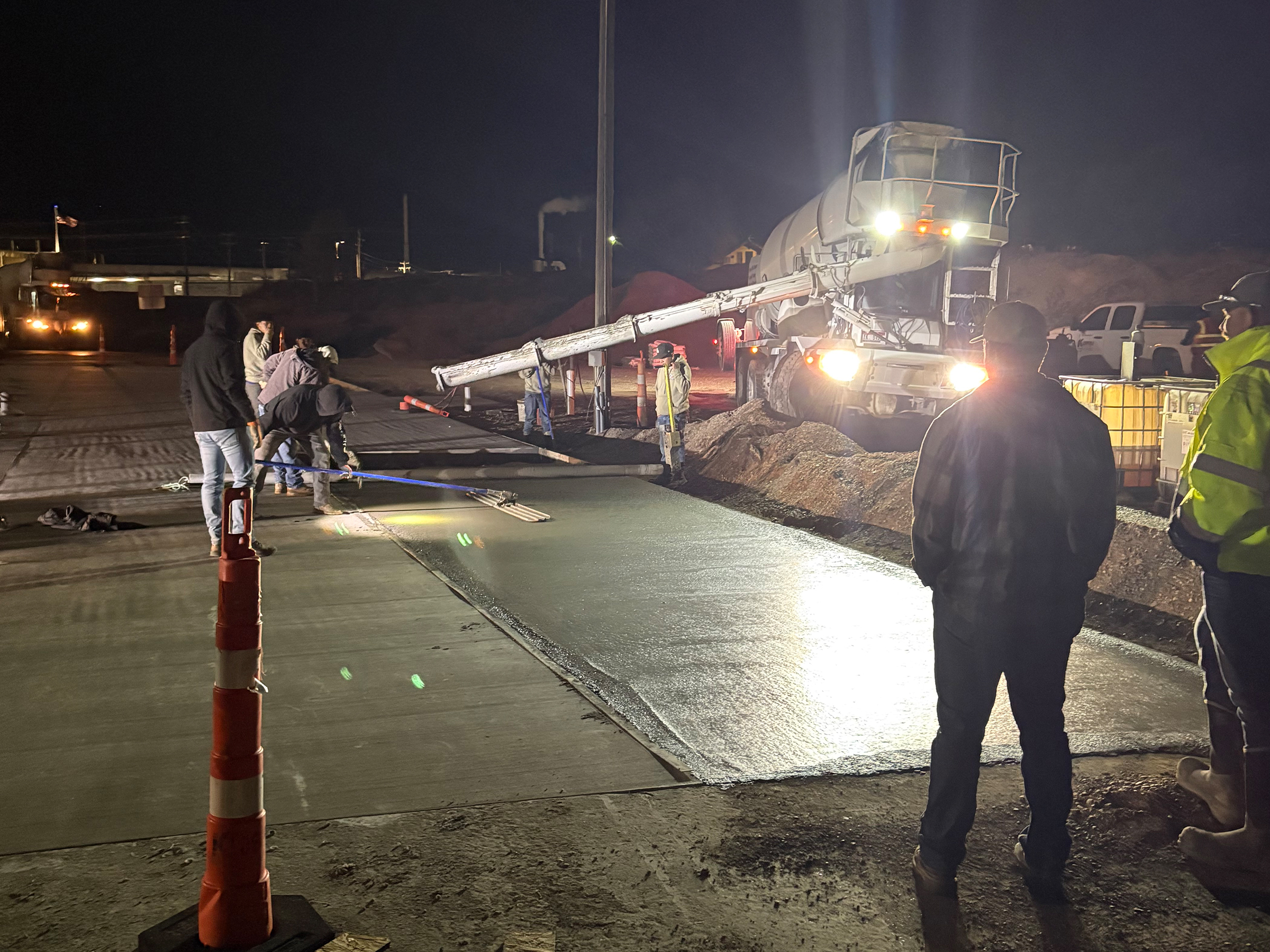
A novel concrete mix developed at Idaho State University took its first steps out of the lab and into the field. Recently, researchers from ISU poured their first pad of Sweetcrete at a Kloepfer Inc. facility in Burley, Idaho.
Sweetcrete utilizes Precipitated Calcium Carbonate (PCC), a byproduct of the sugarbeet refining process at the Amalgamated Sugar Company’s facility in Paul, Idaho, to create an innovative concrete blend that uses less cement and is cheaper to produce while still being as strong as conventional concrete.
"It’s always exciting to see applied research move out of the lab and create real impact for industry and communities," said Jared Cantrell, associate director of strategic partnerships and innovation at ISU. “The deployment marks a critical phase for the project and is a significant milestone for this Idaho-grown innovation.”
The material was used to create an asphalt spray-down rack, which semi-trucks drive through to spray a release agent so asphalt does not stick to the bed of the semi-truck. The rack was a 9-foot-wide by 71-foot-long by 8-inch-thick pad and used a total of 21.5 cubic yards of Sweetcrete. While Sweetcrete has undergone rigorous testing within ISU’s Structural Laboratories (SLABs), the Kloepfer Inc. site provides the real-world stress necessary to validate the mix’s long-term durability and performance in Idaho’s environment.
Mustafa Mashal, associate vice president for research and innovation partnerships and a professor in the Department of Civil and Environmental Engineering, is the principal investigator and lead inventor of Sweetcrete. He emphasized that the work represents a broader vision for applied research and regional impact.
“Sweetcrete demonstrates how university research can translate into practical, scalable solutions that benefit industry while advancing innovation in environmental security,” Mashal said. “By leveraging locally available materials and strong industry partnerships, we are not only improving construction practices but also creating new value streams for Idaho’s economy.”
The development of Sweetcrete has been supported by the Idaho State Board of Education’s Higher Education Research Council, specifically under the Idaho Global Entrepreneurial Mission Grant Program, and ISU’s Office for Research. The success of the pour was made possible through collaboration with industry champions like Aaron Kloepfer from Kloepfer, Inc., and the technical expertise of partners Brian Roberson and Jeff Squibb from Amalgamated Sugar Company.
“I was very intrigued to put Sweetcrete in a controlled environment,” explained Aaron Klopfler. “I knew that it needed to be like a real-life application, but not hazardous to the public — we happened to have just the right application. Ultimately, I saw the opportunity and decided to take it.”
“This project represents an important step forward in finding higher‑value, more sustainable uses for our PCC byproduct,” said Brian Roberson, director of feed products at Amalgamated Sugar Company. “The strong performance results generated by Idaho State University’s Civil Engineering research gave a prominent, local concrete company, Kloepfer Inc., the confidence to advance the work into a full‑scale production trial.” Brian continued, saying “seeing PCC‑containing concrete successfully produced and poured in a commercial setting demonstrates the real potential of this material and reinforces our commitment to supporting innovative, sustainable uses of our byproducts.”
The project also serves as a high-impact learning opportunity for ISU students. Under the guidance of faculty and experts, including Kavita Sharma, Emanuele Zappala, James Mahar, Mahesh Acharya, Kunal Mondal, Jared Cantrell, Tadesse Wakjira, and Jack Liimakka, along with staff lead Joseph Shurtleff, a dedicated team of civil engineering and computer science students is gaining technical knowledge and hands-on experience, including Arpan Adhikari, Prajita Budhathoki, Sameer Budhathoki, Abinash Gautam, Abiral Tiwari, Uddhav Dev, Stephanie Cobos, Koras Koirala, Pravesh Aryal, Harsha Rouniyar, and Rohan Shrestha.
“Being part of a project that explores the use of an industrial byproduct like precipitated calcium carbonate in a meaningful and innovative way is something I take pride in,” said Prajita Budhathoki, undergraduate research assistant. “Seeing how our research can translate into real-world applications has strengthened my research interest and excitement for what comes next from our lab.”
As the Burley pour cures and the data is analyzed, the ISU team is looking toward the future and other candidate projects such as sidewalks, retaining walls, slabs, and foundations.
"Kloepfer, Inc. stepping up to host this live field application is a testament to the value of university-industry partnerships," Cantrell added. "This demonstration is an essential step in evaluating the future of PCC in large-scale construction."
Organizations interested in exploring PCC pours, pilot projects, or applied research collaborations are encouraged to contact Mustafa Mashal at mustafamashal@isu.edu or Jared Cantrell at jaredcantrell@isu.edu.
Categories: