
Learning by Doing: ISU Professor's Research Focuses on How to Best Inspire Future Scientists
September 21, 2026
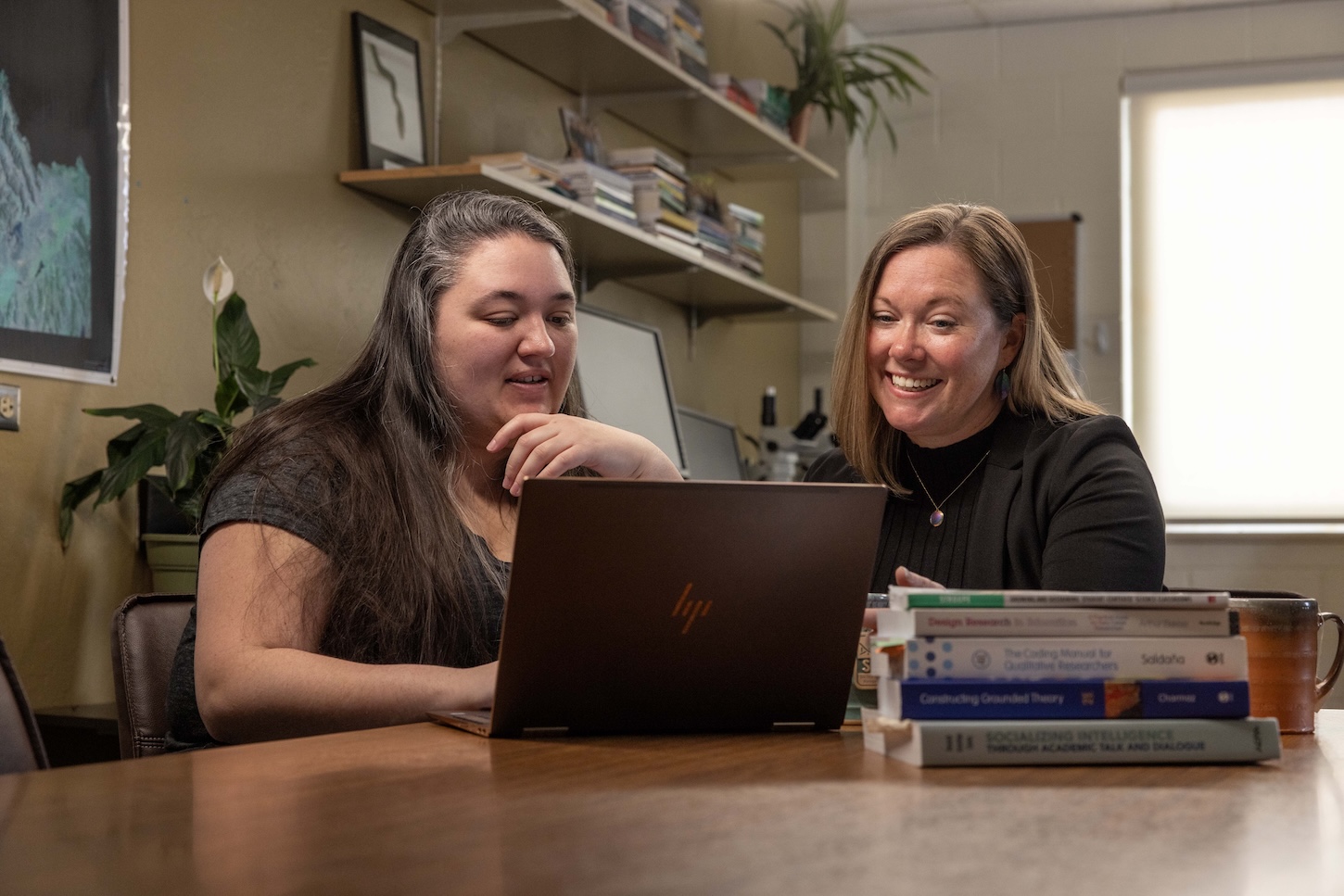
Anna Grinath made a fateful trip to the dollar store as an undergrad.
At the time, she and another student were working in Professor Sallie Sheldon's lab at Middlebury College in Vermont over the summer, tackling research in aquatic ecology.
In the dollar store, Grinath wasn’t shopping for low-priced items to outfit her dorm room. Sheldon sent the lab group on a mission with a hyper-specific aim: tap into their inner MacGyver and find supplies for science.
“We were studying all of the aquatic insects–like dragonfly larvae, mayfly larvae, and caddisfly larvae–and aquatic plants in a lake ecosystem,” said Grinath. “We were looking for things that would prevent some insects from leaving the plant and new insects from coming to the plants, as well as allow light and water to flow through without disrupting the microhabitat.”
While Grinath found several trash cans and some tulle that fit the bill, picking out the precise items she’d use sent the now-associate professor at Idaho State University on a different career trajectory.
“I think that started my interest and appreciation for all of the pieces that go into asking and answering questions in science that often aren’t made visible to us when we’re sitting in a classroom. I was shaping the field of aquatic ecology when I was going down the aisles of the dollar store,” she said.
After Grinath's fortuitous shopping trip and a growing curiosity about how students learn, she furthered her education at Florida State University and was intent on joining academia.
“I had excellent professors that focused on my development as a biologist, and I wanted to be the person who had that impact on future undergraduate biology majors.”
For her master’s degree, Grinath studied coral reef sponges and how the filter feeders eat beneath the waves.
“The things I learned in my undergraduate research experience about designing experiments using everyday materials tracked through my master's degree when I built chambers to study sponges using Rubbermaid containers and those green baskets that strawberries used to come in,” Grinath said.
Like many graduate students, Grinath also taught a handful of courses to undergrads. It’s in these animal diversity and experimental biology lab courses where she cemented her fondness for teaching.
“I found out how much I love teaching and also bringing my analytical side and thinking a lot about how I best teach,” said Grinath. “For instance, if something didn’t go well in my first class, could I systematically try different things in my next class to try and understand and be the most effective teacher I can be?”
After earning her master’s, she began her doctorate at FSU. While her previous two degrees were in biological science, this final one would be in curriculum and instruction with a focus on science education, allowing her to bridge her research and teaching interests.
“My dissertation research focused on biology teaching and learning. I was able to ask questions about how students learn biology with implications for what are effective practices for teaching biology.”
She received her doctorate in 2017, and after a two-year stint as an assistant professor at Middle Tennessee State University, Grinath headed west to Idaho State University in 2019. As an institution, ISU has honed in on the teaching side of biology since the 1970s by offering a Doctor of Arts in the field. The Carnegie Foundation for the Advancement of Teaching provided seed funding for 10 universities across the United States to institutionalize the degree, which seeks to “develop the skills of people interested in teaching at the undergraduate level.”
“The biological sciences department here at ISU is really special because you can see and feel how committed everyone is in supporting our undergraduate majors to develop as biologists and become involved in the departmental community,” said Grinath. “I decided to join the biological sciences faculty at ISU because it was important to me that my biology colleagues were student-focused and invested in effective approaches for biology learning and teaching."
Historically, the end goal of science education was for students to memorize concepts and processes, according to Grinath. In the last couple of decades, however, educators have shifted from focusing on what is known to honing in on the hows and the whys.
“If we just focus on what we know, we’re missing a critical piece of it,” explains Grinath, “and that critical piece is how we came to know it. For example, students need to understand not only the process of photosynthesis but how did people go about figuring that out to begin with and the practices and processes biologists draw on to generate new knowledge.”
As the head of the Biology Learning and Teaching Research Lab at Idaho State University, Grinath’s research includes designing instructional materials, identifying effective teaching techniques, and creating professional development opportunities for educators to maximize student involvement. Some of the projects Grinath and her students have tackled are using art as a way to learn about snakes, having classroom discussions of research articles to help students recognize themselves as part of a scientific community, and how to design a research-based course where students take ownership over the research project, to name a handful.
“I study supporting students' ability to shape science through participating in science,” said Grinath. “We recognize that deep understanding involves learning through participating and doing. We want students to see themselves as someone who can shape the future of science.”
“Being a graduate student in Dr. Grinath's lab allowed me to explore my questions about how students learn biology and see themselves in science in so many different ways,” said Gabrielle Jablonski, a former graduate student of Grinath’s who is now teaching high school biology in Idaho. “I am grateful for that experience not only because of the skills I gained in research and teaching, but also because of the impact these skills had on my future career.”
Grinath’s work received a major boost from the National Science Foundation and an over $600,000 grant from the Faculty Early Career Development Program. Known as CAREER awards, they’re some of the NSF’s most sought-after and are given “in support of early-career faculty who have the potential to serve as academic role models in research and education.” She joins an all-woman cadre of researchers at ISU who’ve received CAREER awards in recent years, including fellow faculty members Sarah Godsey, geosciences, Devaleena Pradhan, biological sciences, and Cori Jenkins, chemistry.
“This is an exciting opportunity for Dr. Anna Grinath to do important research on how students build their science identity in courses where they are doing science, not just learning about it,” said Janet Loxterman, professor and chair of the biological sciences department at ISU. “Dr. Grinath is deserving of this prestigious award, and we are extremely lucky to have her as a colleague in the Department of Biological Sciences.”
Grinath’s CAREER grant, “Supporting Students’ Agency to Shape Science Practices — From Field Stations to Classrooms,” seeks to develop new understandings of how students can and do make decisions about the science they are involved in, how educators can foster participation in the research process, and how that participation relates to science learning.
For the past two summers, Grinath has spent time at the Rocky Mountain Biological Laboratory in Colorado. Located in what remains of the abandoned mining town of Gothic, RMBL offers courses, programs, and research experiences for students as well as a field base for researchers to study topics ranging from biogeochemistry to hydrology, animal behavior, and more. Her subjects haven’t been the plants, insects, or mountains at RMBL. Instead, she’s been studying the animals of the two-legged variety.
“I've spent the summers alongside the undergraduate students and describing how they develop as biologists by designing and carrying out their independent research project and then communicating their findings to the RMBL community,” Grinath said. “I’ve also interviewed the students' mentors to describe effective strategies for fostering a mentee's research confidence and independence. I’m planning to translate what I learn from studying a 10-week immersive summer research experience into design recommendations for research experiences that take place through course-based research experiences."
Back on Idaho State’s Pocatello campus, Grinath will also conduct a similar study and examine how to cultivate participation in course-based research experiences such as ISU’s Bacteriophage Discovery and Genomics class and the Vertically Integrated Projects courses. Bacteriophages are viruses that infect bacteria, and the two-semester course sees students work through every step of the phage identification process, from collecting their first samples to writing a scientific paper discussing their findings. Meanwhile, the VIP courses see undergraduates, graduate students, and faculty work on a multi-year research project. Projects under the VIP umbrella range in topics from sagebrush genetics and molecular microbiology to immunotoxicology, neurobiology, and more.
“The variety of course-based research experiences offered by the biological sciences department provides a welcoming environment for students to work with a team on a research project for a semester and earn academic credits,” said Grinath. “The hope is to lower the barriers for first and second-year students to explore whether they even like the research process and what flavor of biological research excites them. Once they find a good fit, they can continue with the same project for multiple semesters.”
Grinath will also examine how educators in classroom and field settings can increase student participation and the hurdles they face in boosting student involvement. After the five-year research project, Grinath plans to provide specific and actionable information to science educators to drive student engagement and learning in their biology courses.
"My research will generate new knowledge on how undergraduate students' ideas take research projects in new directions and how such research experiences are important for their learning and development as scientists,” said Grinath. “These research findings will help educators to design course-based research experiences to intentionally involve students in contributing ideas, making decisions, and developing ownership in the research process."
At the end of the day, Grinath’s work is about developing and inspiring the next generation of scientists who can bring their unique thoughts, experiences, and solutions to the table, much like she was tasked with as she went up and down the aisles of a Vermont dollar store.
“With each new person that enters into doing science, we have the opportunity to have new people shape research and the more invisible aspects of research, like the how and the what of collecting data,” said Grinath. “That is the place where a first-semester undergraduate student might be best positioned to bring new creative ideas that can valuably shape the direction of that research project.”
Learn more about ISU’s Department of Biological Sciences at isu.edu/biology.
Categories: