
ISU Professor Emeritus Publishes New Book on Cancer, Cancer Treatments
August 20, 2026
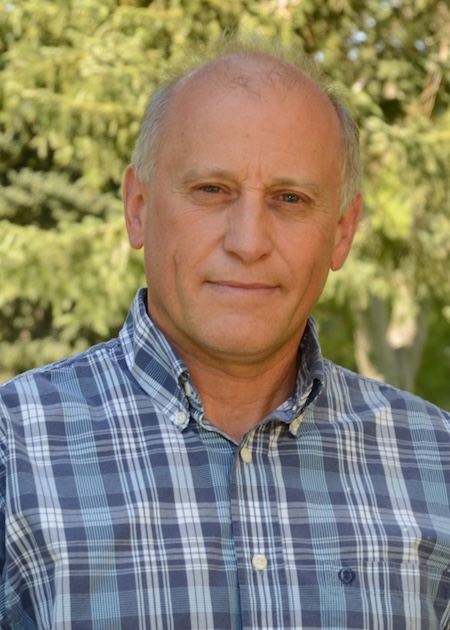
The insights math can provide on cancer and its treatment are the subject of a new book by an Idaho State University Professor Emeritus.
The insights math can provide on cancer and its treatment are the subject of a new book by an Idaho State University Professor Emeritus.
Recently, De Gruyter published Leonid Hanin’s latest book, Modeling Cancer Progression and the Effects of Treatment: Mathematical, Statistical and Computational Methodologies with Clinical Perspectives. Over the book’s 266 pages, Hanin “combines methodological, mathematical, statistical and computational sides of cancer modeling with biomedical and clinical insights,” as well as how “understanding cancer-related processes through mathematical modeling reveals unobservable aspects of the natural history of cancer and unexpected effects of treatment.”
“Cancer cases among my friends, colleagues and families that I witnessed first-hand over the last quarter century gave me both motivation and food for thought,” Hanin said. “The overarching goal of the book was to provide cancer patients with basic knowledge of cancer and the effects of treatment that would help them to ask the right questions, know when to seek a second opinion, and overall to develop more equitable partnerships with treating physicians.”
Before being granted emeritus status by ISU in 2023, Hanin’s research at Idaho State mostly focused on mathematical modeling of biomedical processes and solving statistical problems in the biomedical sciences. His latest tome is the third book he’s written or edited in his career, with the other two published in 2008 and 1994.
“Working in the field of mathematical oncology allowed me to combine two academic passions of my life since middle school: math and biomedical sciences,” said Hanin. “Despite enormous progress in molecular biological understanding of cancer, the latter largely remains a mysterious disease and a daunting challenge for healthcare. One reason is that there is a fundamental difference between solving problems in natural sciences or engineering and treating cancer. The former problems, no matter how complex, are fixed in that they don’t change when attempts are made to solve them. By contrast, cancer treatment can change in fundamental ways the course of the disease and often make it worse.”
For more information on ISU’s Department of Mathematics and Statistics, visit isu.edu/math.
Categories: