
Playing with Purpose: ISU Doctoral Grad’s Research Explores Therapeutic Uses of Video Games
December 18, 2025
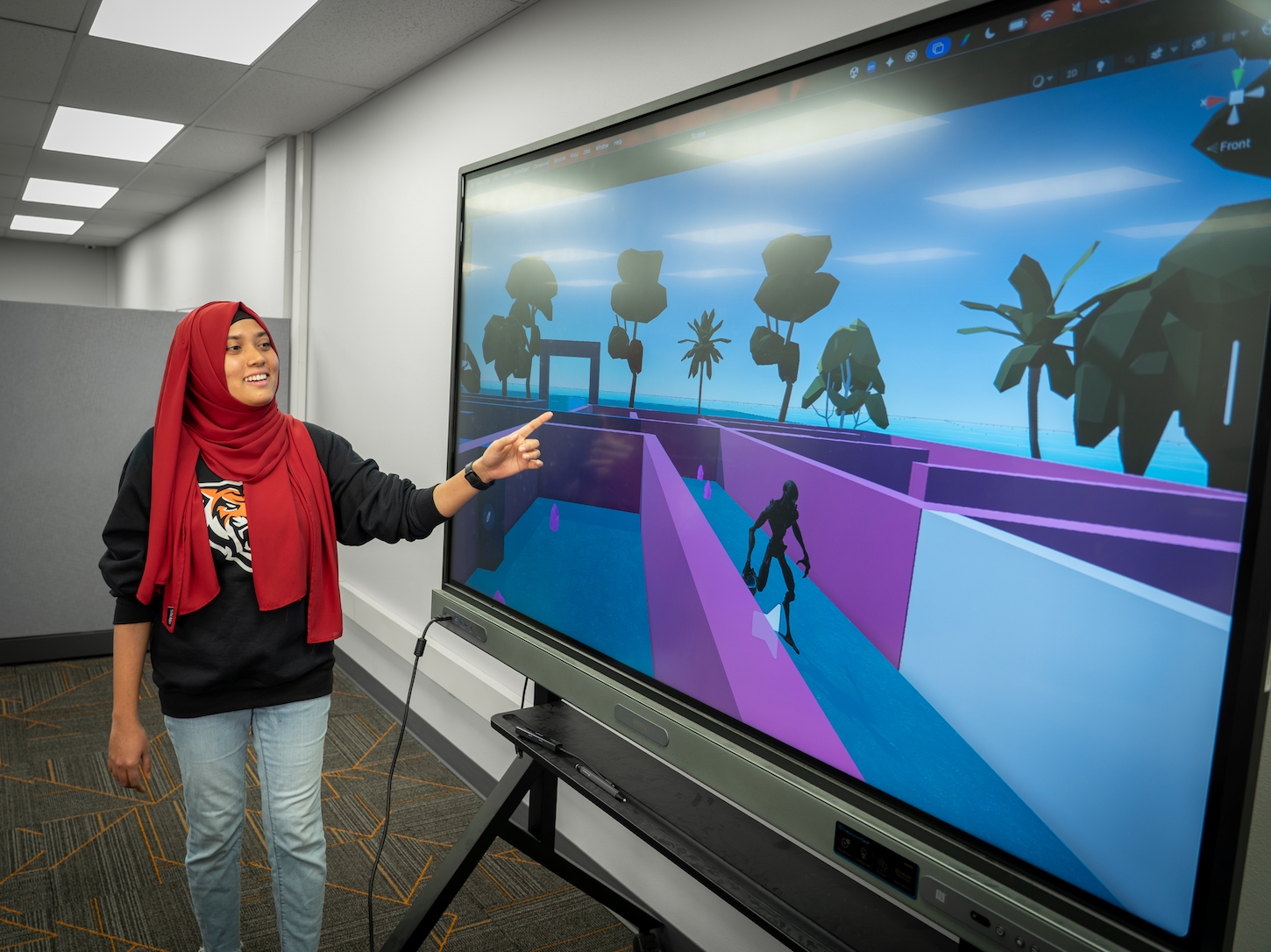
Gaming is serious business for Rifat Ara Tasnim.
The recent doctoral graduate from Idaho State University isn’t fixated on the likes of Minecraft, Fortnite, Roblox, or the latest Battlefield. For nearly six years, Tasnim’s sights have been trained on the niche of serious gaming.
“Serious games are designed to serve other purposes rather than just pure entertainment,” said Tasnim. “I actually learned about serious games after I started my doctorate, and the field immediately stood out to me. I found it fascinating that a game can go beyond entertainment and support learning and emotional well-being. That idea made me want to explore it further.”
Tasnim first earned a bachelor’s in computer science from Khulna University of Engineering & Technology in Bangladesh. After a brief stint as a software engineer, she found herself at the University of New Orleans in Louisiana in the fall of 2019, working on a doctorate under the guidance of Farjana Eishita, who was serving as an assistant professor at the institution at the time.
“When I discovered her research profile and the work she was doing, especially in areas like human–computer interaction, serious games, and immersive technologies such as augmented reality and virtual reality, I felt it was exactly the direction I wanted to pursue,” Tasnim said.
“Rifat’s confidence and respectful behavior caught my eye,” said Eishita. “Eventually, her enthusiasm and perseverance distinguished her as a dedicated and resilient scholar.”
Two years later, Eishita joined the faculty at ISU, and Tasnim moved to the Gem State as well.
“I really enjoyed doing research under Dr. Farjana’s mentorship,” said Tasnim. “When she moved to ISU, she generously offered me the opportunity to continue working with her. I knew I wanted to keep developing my research with her guidance, so I followed. I also looked into ISU and found that the program, the campus, and even Pocatello itself felt like a great fit for me. In the end, coming here turned out to be one of the best decisions I’ve made. I get to work in an environment I genuinely enjoy while continuing my research with a supervisor I work well with.”
Working out of Eishita’s Research in Intelligence, Games, and HCI Techniques Laboratory, the research team focuses on developing purpose-driven gaming experiences.
“The goal of the RIGHT (Research in Intelligence, Games, and Human–Computer Interaction Techniques) Lab is to advance human-centered technologies through interdisciplinary research in HCI, video games and user experience, AR/VR/MR, and usable security,” Eishita said. “The lab aims to design, develop, and evaluate interactive systems that are engaging, immersive, secure, and accessible, with a strong emphasis on improving user experience, learning, and well-being. Through innovative research, prototyping, and collaboration, the RIGHT Lab seeks to bridge theory and practice while preparing students to create impactful, ethical, and user-friendly interactive technologies.”
For Tasnim, her first serious game was Militant of the Maze, a game for handheld devices that had players navigate a maze full of obstacles and make it out. The wrinkle for the player is that there are obstacles in the way, and they have to use cognitive behavioral therapy–known as CBT, it’s a common therapy technique that aims to change negative thoughts into positive ones–to navigate around them.
“The main challenge was to design serious games that incorporate different psychotherapy techniques, and we chose CBT,” Rifat explains. “Our goal was not to provide therapeutic treatment through the game; however, we wanted to explore how the integration of these techniques in the gameplay impacts players and how it affects their emotions, how the game functions as a serious game, and how the outcomes change based on players’ personality traits. We were also interested in how players experience the game. The idea was that the overall findings could be used to design future games for psychotherapy, or to help someone qualified take these games further for clinical trials.”
After using Militant of the Maze to explore the treatment procedures of CBT, Tasnim developed ARCoD that explored the screening procedures of CBT and also looked into the impact of different game environments like AR, VR, and smartphones on game outcomes and player experience. For her dissertation, “Analyzing the Impact of Serious Games to Facilitate the Efficacy of Psychotherapeutic Techniques,” Tasnim explored how much therapeutic value gameplay alone–without biofeedback systems like heart rate monitors or therapist involvement–could provide to the player.
“Through multiple experiments across smartphone, AR, and VR platforms, I examined how game environments and personality traits influence both therapeutic outcomes and player experience,” Tasnim said. “The findings reveal meaningful connections between these factors, offering insights into how serious games can be designed to improve their effectiveness and overall player experience.”
During her time at Idaho State, Tasnim also took on two internships. The first, with Idaho National Laboratory, saw her develop an immersive VR simulation of a nuclear reactor for educational purposes. Meanwhile, the other saw her venture into the world of chemical data analysis with ISU’s Department of Chemistry, and integrate haptic feedback into a chemical data analysis visualization tool, supporting accessibility for blind users. She also served as a guest lecturer and has earned a slew of awards for her research.
“I had the chance to work with advanced technologies like VR and AR, which helped me become familiar with cutting-edge tools and platforms,” Tasnim said. “Being part of a supportive research environment also helped me grow as an independent researcher. I learned how to design studies, analyze data, write papers, and manage long-term projects with confidence. Also, I have received multiple grants from graduate school and CoSE to present my work at conferences, which have strengthened my communication and networking skills.”
“I am confident that Rifat will continue to grow as an innovative researcher, making meaningful contributions to her field,” Eishita said. “She will be a role model through her dedication, integrity, and passion for excellence.”
As for the future, Tasnim says she plans to pursue a career in academia after earning her doctorate, allowing her to teach and focus on her research.
“I plan to continue my research in Human-Computer Interaction, Serious Games, and Extended Reality (VR/AR/MR). I aim to expand my work on real-time adaptive gameplay, where games dynamically adjust challenges based on players’ emotional or behavioral responses,” said Tasnim. “I also intend to design interactive VR tools for data visualization that allow users to explore complex datasets through intuitive, hands-on interfaces. Additionally, I would like to investigate the concept of a digital twin for human well-being using wearable data.”
For more information on ISU’s Graduate School and the Department of Computer Science, visit isu.edu/graduate and isu.edu/cs, respectively.
Prospective students can schedule a campus tour at isu.edu/visit.
Categories: