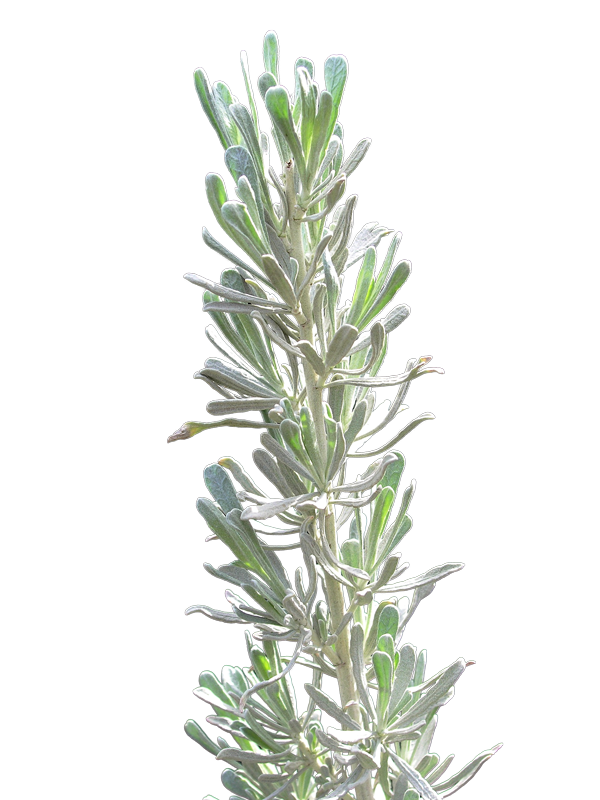
“Hazho’i inleh.” These two Navajo words were spoken to Veronica Miller countless times by her grandmother.
Miller had heard the near constant refrain to “do it right” while learning to process greenthread plants for Navajo Tea during her childhood. In the summers, the pair would work side-by-side to meticulously prepare each wiry plant for the traditional drink.
“You collect the plant, then you cut it, then rinse it, then fold it and put it into the tea bag, then dry it, and then store it,” explains Miller, a student at Idaho State University.
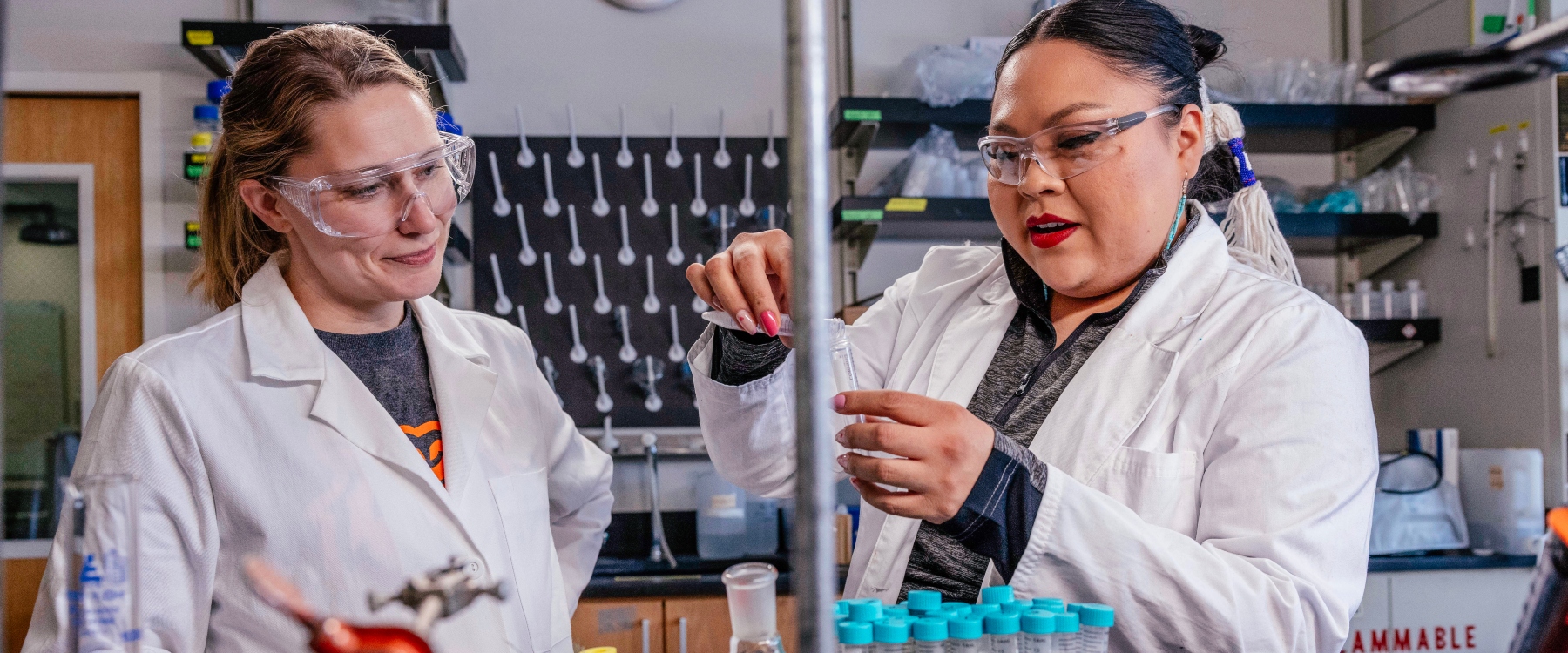
In the sterile environment of a chemistry lab on ISU’s Pocatello campus, the same steps, movements, and mantra of “hazho’i inleh” Miller learned in her youth were put to good use once again as she processed plants for her experiments into green adhesives.
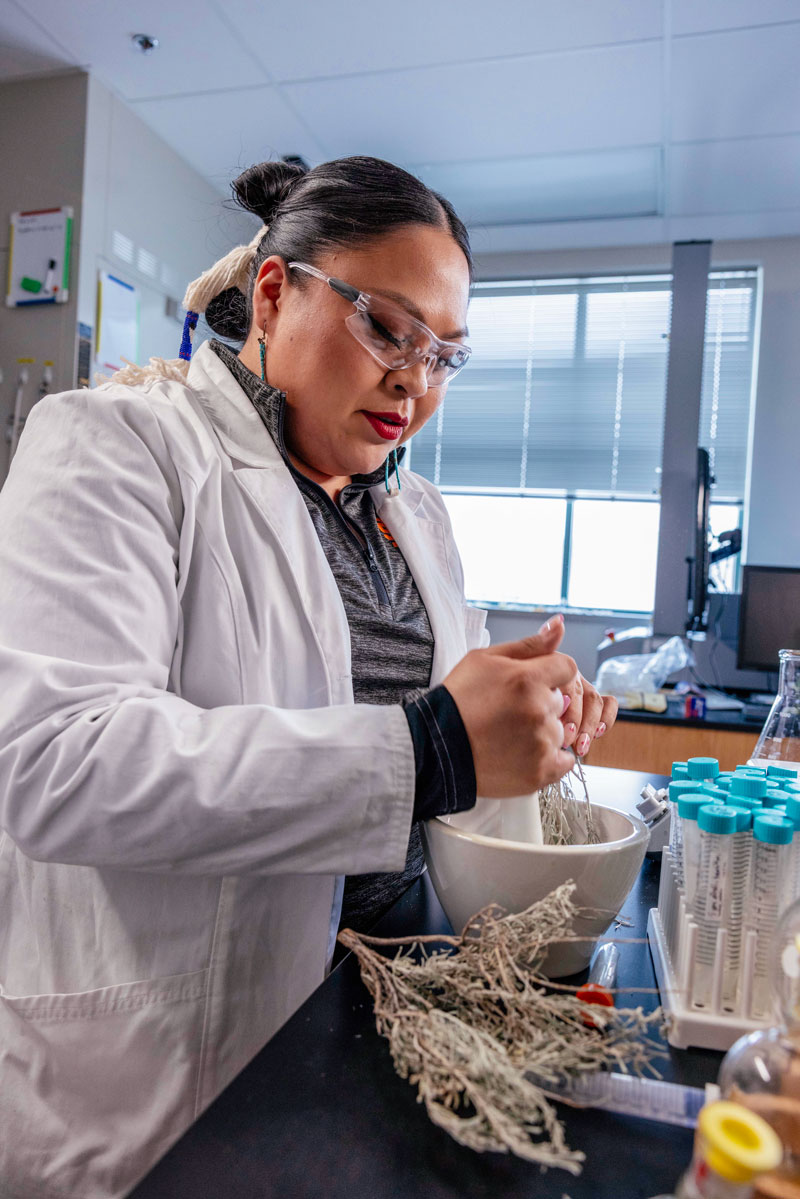
“It was astonishing that an ancient skill passed on to me from my people could be applied to modern chemistry research, and it was moments like this that proved to me that I not only brought unique skills that could be used in the research, it proved that I belonged in research,” she said.
After spending her youth in rural New Mexico, Miller made her way to Idaho State, planning to become a physician assistant. One of the courses she was required to take was Chemistry 1101: Introduction to Chemistry. This course and Miller’s instructor, Andrew Bernard, roused an interest in the field.
“I noticed that Veronica showed a curiosity about the material past what most students taking this course display,” Bernard said. “She would regularly stay behind during my office hours, and we would discuss some of the more interesting aspects of chemistry beyond what we covered in class.”
“He knew before I did that I really enjoyed chemistry,” Miller said. “Chemistry answers so many questions, and I enjoy thinking at the tiny, molecular level. There’s a lot of mystery involved with chemistry in things like how particles behave and why they behave that way on the molecular level. There’s a lot of creativity involved with it, too.”
And it wasn’t long before Miller changed majors to chemistry. Still a freshman, she started working as a student researcher in the lab of Associate Professor Cori Jenkins, Ph.D. and was tasked with helping to develop renewable adhesives.
“I didn’t know how to draw molecular structures, the names of the glassware, how to operate the lab instruments, or find tools,” said Miller. “I also struggled with confidence in the lab as a Native American student. I often felt that I was in an entirely different world that wasn’t made with me in mind. Native representation in the chemistry research field is severely lacking, and this lack of representation made me feel out of place and apprehensive.”
Slowly but surely, Miller overcame her uneasiness. During a summer research fellowship between her freshman and sophomore years, Miller explored the performance of different sustainable adhesives made with garlic essential oils and extracts from plants like juniper, sagebrush, dandelion, and other common weeds.
“A lot of my research touches on my core beliefs in terms of being good stewards of our land as Native American people,” Miller said.
It was when she was processing the cuttings, and with her time spent with her grandmother processing the greenthread on her mind, she found her footing.
“From that point on, rather than being embarrassed at my differing perspectives and experiences as a Native American, I embraced it,” Miller said. “I believe having different perspectives in chemistry can help solve problems in research or industry.”
Over the summer, Miller continued to cement herself in the field. That fall, she showcased her efforts at ISU’s Indigenous Peoples’ Day Research Showcase in full Navajo regalia and netted a first-place prize for undergraduate research.
“I saw my two worlds converge, and it made me feel proud as both a chemist and a Native American,” said Miller. “A common saying among my people is ‘A win for one is a win for all,’ and I felt that the hours spent working in the lab benefited my career and, more importantly, my people.”
Now a junior, Miller has published one research paper on her work with green adhesives, and another is on the way. She also serves in several chemistry-focused roles on campus and is a past vice president of the Native American Student Council, in addition to continuing her research. In 2024, she received a Goldwater Scholarship and repeated her first-place performance at the Indigenous Peoples’ Day Research Showcase.
In 2024, she was selected from a pool of over 1,300 applicants representing more than 440 academic institutions to receive a Goldwater Scholarship, which seeks “to identify, encourage, and financially support outstanding undergraduates interested in pursuing research careers in the sciences, engineering, and mathematics.“ That same year, she also repeated her first-place performance at the Indigenous Peoples’ Day Research Showcase and wrote a grant proposal to establish a program aimed at reducing solvent waste in the chemistry department, funded by ISU’s Department of Environmental Health, Safety, and Sustainability.
“Over the last two years, I have watched Veronica transition from an efficient technician to an independent scientist,” said Jenkins. “She is a leader in the laboratory and is already setting herself up to excel beyond her time at ISU.”
As for the future, Miller is planning to earn her doctorate and hopes to have a lab of her own.
“I want to transform how people—especially Native communities—perceive chemistry,” said Miller. “I want them to see its beauty, approach it without fear, and know that it’s within their reach. Even when a class feels intimidating, my professors’ confidence in me pushes me to believe in myself. That’s the impact I want to have on future scientists, particularly Native students. I want to be the voice that tells them, ‘You can do this,’ empowering them to embrace their potential and discover their own strength.”