
More Laboratory Space, More Health Professionals, More Healthcare Access for Idahoans
September 17, 2026
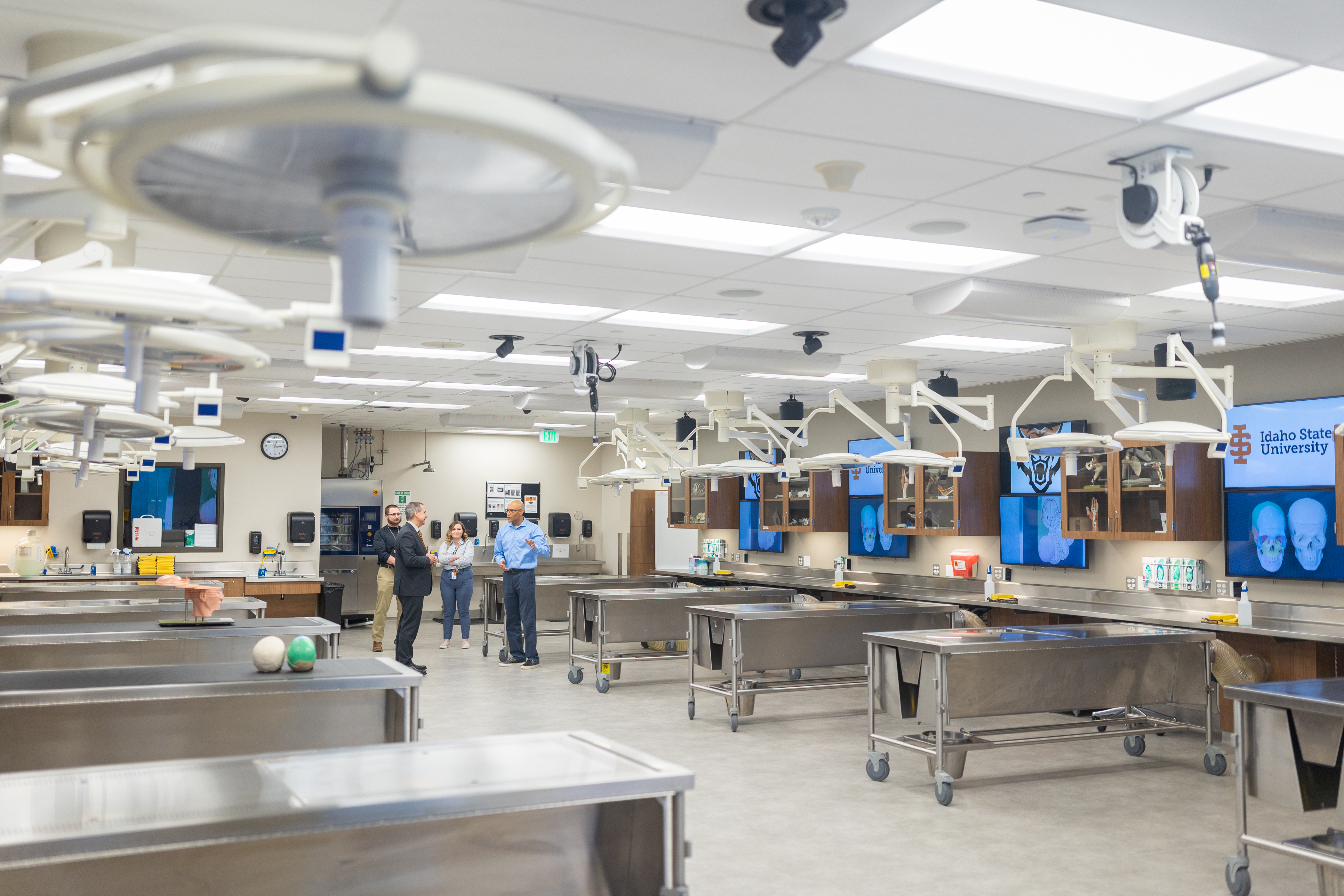
Access to health sciences education in Southwestern Idaho will soon increase with the expansion of the L.S. and Aline W. Skaggs Treasure Valley Anatomy and Physiology Laboratories (TVAPL) on Idaho State University’s Meridian campus.
The project, approved by the Idaho State Board of Education, is a collaboration between Idaho State University (ISU), Idaho College of Osteopathic Medicine (ICOM), and University of Idaho (U of I).
Construction of the expanded spaces is slated to begin later this fall and will focus on the addition of a 16-station human anatomy lab to the existing 34-station lab, along with a two-station embalming suite. The 6,130 square foot remodel will take place in retired laboratory space adjacent to the current TVAPL location within the Sam and Aline Skaggs Health Science Center and will cost approximately $7.9 million.
TVAPL is a unique core lab facility offering a modern, comprehensive space that combines high-quality virtual, donor-based, and professional anatomy education, training, and research. The health sciences hub also provides opportunities for learners at every level. Working healthcare professionals can receive continuing education and community members can experience healthcare-specific career exploration events.
Dr. Padma Gadepally, director of anatomy laboratories and clinical assistant professor, notes there are only a handful of professional educational and research laboratories like TVAPL in the United States, with core missions of taking care of anatomical donors, supporting learners at various levels, community outreach efforts, and state-of-the-art laboratory facilities.
“We have a decade of very successful operations under our belt. We started with about 50 learners and now have upwards of 2,000 learners, all while not sacrificing any part of the core mission of the labs,” said Gadepally. “We’ve strived hard to meet the needs of diverse learners across the spectrum. We have doctoral, medical, and graduate learners across the breadth and length of health professions, along with undergraduate, high school, and life-long learners. Through the annual Health Science Experience Night, even younger learners in middle and elementary school and their families can come in and visit the labs.”
TVAPL is operating at maximum capacity at its current size, leaving little room for program flexibility or growth. As the exclusive anatomy training facility for ICOM — Idaho’s only medical school — TVAPL is imperative in addressing Idaho’s physician shortage. In Fall 2025, ICOM increased their enrollment by 75 students per cohort, creating a more urgent need for the remodel.
"The expansion of the Treasure Valley Anatomy and Physiology Laboratories represents an exciting investment in the future of healthcare education in Idaho. By strengthening our partnership with Idaho State University, we are expanding opportunities for ICOM students to learn in a collaborative, state-of-the-art environment that enhances their anatomical education and prepares them to become excellent physicians. This project reflects our shared commitment to educating the next generation of healthcare professionals and ensuring Idaho communities have access to highly trained providers for years to come." said Blaine Maley, PhD, chair of anatomy at ICOM.
Similarly, the collaboration aims to allow a proposed Treasure Valley-based undergraduate medical education collaboration between the University of Utah and the U of I to use the state-of-the-art facilities, expanding the education and training available for future physicians.
"This is the kind of partnership Idaho needs to grow its own healthcare workforce,” said Dr. Rayme Geidl, co-director of the University of Idaho School of Health and Medical Professions. “Collaborations like this show what's possible when Idaho institutions work together."
The expansion will also allow ISU to create the first university-based willed body donation program in the Treasure Valley, creating an ethical in-house system for procuring donors who willingly and generously donated themselves to train future Idaho medical providers. Willed body donation entails the purposeful postmortem donation of one’s body, typically to an educational facility for use in teaching or research.
ISU is committed to educating through the best evidence-based practices, and human body dissection is still considered the gold standard of anatomy education. However, procuring anatomical donors can prove difficult for universities without on-campus facilities and willed body donation programs.
Differing from the live organ donation that people can opt in to on their drivers license, anatomical body donation consists of whole body donation after death. In willed body donations, donors and/or their families have autonomy in deciding if and where they would like their donation to go, giving them a choice on where their impact on healthcare education will be. Human body donation also alleviates the high costs of burial or cremation, while simultaneously providing an invaluable service to the healthcare field.
Creation of the ISU Anatomical Donation Program (ADP) would allow for members of the community to donate their bodies to local scientific education and research. Currently, potential donors in the Treasure Valley have to travel to Pocatello for their donation, which can pose a logistical challenge for them and their families.
Even with these challenges, ISU’s Pocatello-based donation program has received over 300 donations from Treasure Valley residents since 2020. So far in 2026, more than half of donor inquiries have come from the valley, highlighting the community’s interest in anatomical donation despite lack of access.
Finding donors can be time consuming and expensive for universities as well, especially for those in rural states like Idaho. Due to needing external partnerships to process donations and the traveling required between facilities, procurement and transportation costs add up quickly, leaving little budget room left to increase faculty numbers or buy modern educational tools. With an entirely closed-loop system, ISU educators will have more time to dedicate to student success without the strain of procurement logistics.
Ethical willed-body donation entails transparency with potential donors, swift preservation of donors with minimal cost to their families, and ensurement of respectful interactions with the donors throughout their time on campus. When donations are no longer viable for educational use, donors are honored by the students who learned from them before their final disposition and return to their families.
"Establishing this in-house will support growing programs and create a sustainable, self-sufficient future for this vital educational resource for health science students and the community,” said Gadepally.
Categories: