
Serious Gaming
Researchers are developing a virtual reality game to study classical literature.
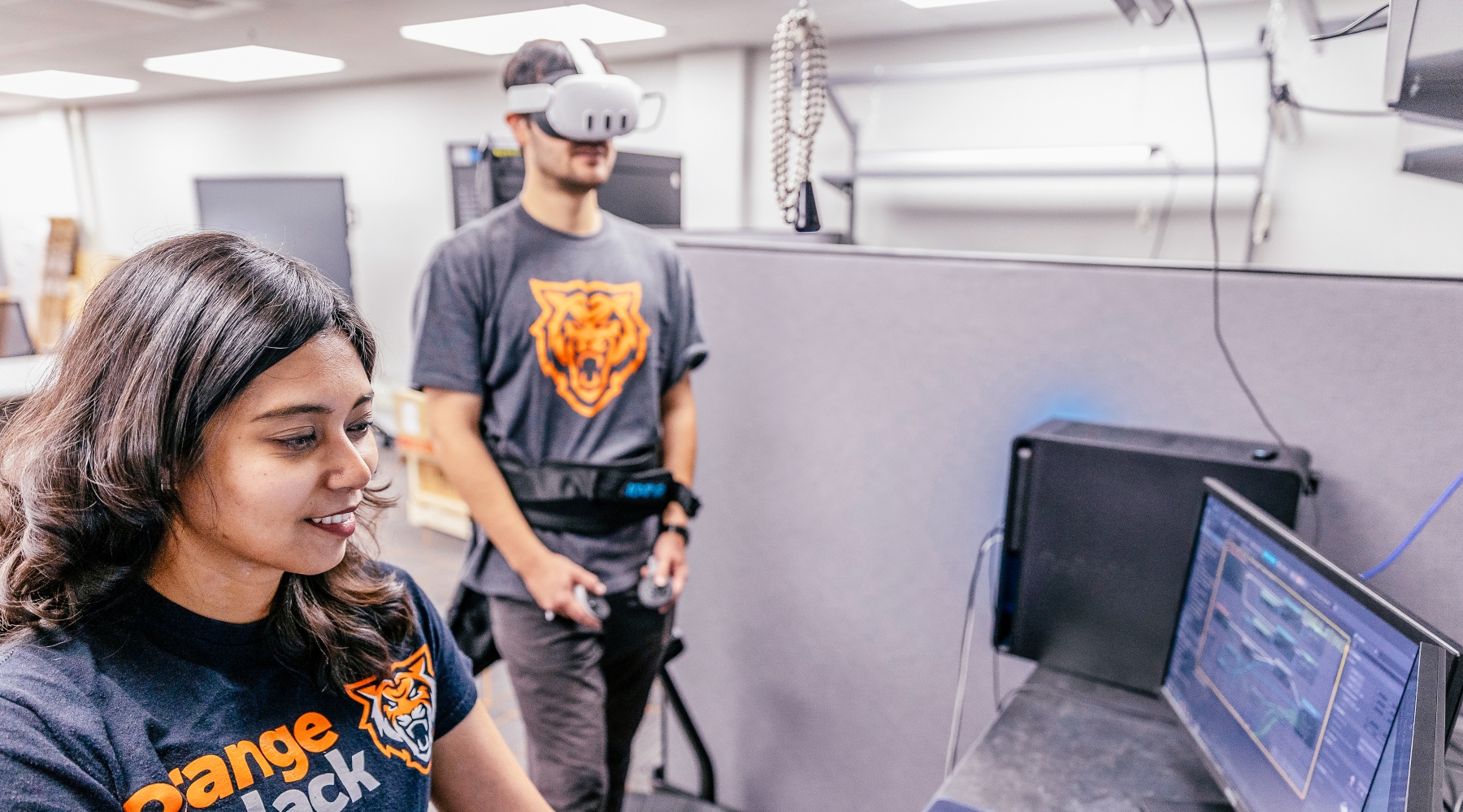
How students learn about the classics by Shakespeare, Dickens, and Austen may soon not be from the page but from the inside of a virtual reality headset, thanks to the work of two Idaho State University researchers and their students.
Farjana Eishita, assistant professor in the Department of Computer Science, and Curtis Whitaker, professor in the Department of English, have joined forces to develop a VR game set in Renaissance-era London. With a working title of Lit-VR, the game isn’t a run-of-the-mill first-person shooter or survival game; Lit-VR is what’s known as a serious game.
“Serious games are a type of game designed with a primary purpose beyond entertainment, such as education, training, healthcare or social awareness,” said Eishita, an expert in utilizing gaming in learning environments. “These games blend engaging gameplay mechanics with meaningful content to achieve specific outcomes, such as teaching skills, promoting behavioral change or solving real-world problems.”
Once a player dons the headset and steps into the world of Lit-VR, they’re spawned at Westminster Abbey in the 17th century. In the first moments, players will visit Poets’ Corner to collect information about classical authors. After that, they’ll make their way around the capital of England, visiting iconic landmarks such as the House of Commons, Shakespeare’s Globe, and London Bridge, along the way collecting rewards and learning more about the literature of the era, the English government and geography. In the final stages – and if a player has accumulated enough rewards – they’ll head to the London Docklands to discover a destination overseas.
“Much of English literature, especially during the Renaissance, is in fact London literature, so getting to know the city takes students a long way in understanding the geographical and historical context of English literature in general,” Whitaker said. “The game will improve students’ understanding of the English literary tradition by allowing them to visualize London locations discussed in the poems and plays they’re reading.”
“Our goal is to develop a gamified learning platform for college-level students to enhance their learning experience,” said Eishita. “By exploring themes, settings and narratives from historical texts, students gain insights into the cultural, social and philosophical underpinnings of the era.”
The researchers completed an initial prototype of Lit-VR in the spring of 2026. From there, they aim to introduce a new in-game location with new narratives and gameplay.
“Working on Lit-VR has been a privilege and an incredible learning experience,” said Reece Foulkrod, a junior majoring in computer science who’s working with Eishita and Whitaker to develop Lit-VR. “I came into the project with limited game design experience, so much of the work has involved learning new skills and researching how to implement specific features. Since the game is meant to authentically represent 1600s London, I’ve also spent a good amount of time researching what the city looked, felt and sounded like during that period to help make the experience as accurate and immersive as possible.”
“The future of VR learning is promising, with the potential to become a mainstream educational tool,” said Eishita. “As technology becomes more accessible and content diversifies, VR could revolutionize education by offering personalized, hands-on experiences that transcend traditional classroom boundaries.”
Ties to the Past
Alumni Who Transformed Their Field
Numerous Idaho State alumni have made a profound impact in their fields through research. These are just a few examples.
Dr. Peter Frischmann
B.S. Chemistry | 2005
Frischmann co-founded Sepion Technologies, named one of the “10 Start-ups to Watch” by the American Chemical Society for pioneering lithium-metal batteries that boost electric vehicle range and sustainability.
Dr. Robson Bonnichsen
B.A. Anthropology | 1965
Bonnichsen was an influential anthropologist whose work reestablished the understanding of the first humans in the Americas. After graduating from Idaho State, he became a master flintknapper, founding the Center for the Study of Early Man to promote research on ancient human migration. His innovative studies and leadership helped establish First American Studies as a major scientific field internationally.