
Powering the Future of Nuclear Energy
A piece of 1950s-era tech, the AGN-201 reactor, will help guide the industry forward.
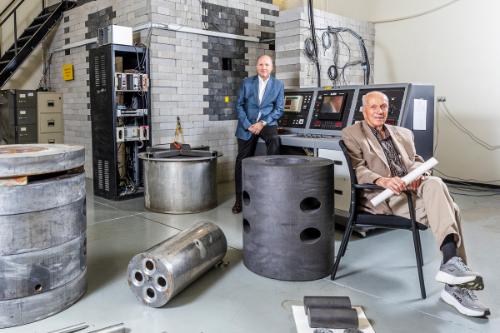
Idaho State University’s on-campus reactor has helped Bengals lead the way in nuclear energy for more than 60 years. Now, this piece of 1950s-era tech will help guide the industry into the future.
The reactor–model AGN 201—was developed by Aerojet-General Nucleonics and touted as “the world’s first mass-produced nuclear reactor,” precisely “designed specifically for universities.” At one point, more than 40 of the low-power reactors were in use.
“AGN-201’s are safe and simple in terms of their design,” explains Chad Pope, professor of nuclear engineering. “The design features multiple failsafes, including four control rods – only one is needed to shut the reactor down – and a thermal fuse that will trip and shut the reactor down if it gets too hot. They utilize solid fuel, and there are no pumps, pipes or valves for coolant since it generates only a minimal amount of heat.”
Idaho State is the proud owner of the third one made.
“They don’t have great documentation on their own reactor, but their estimated date for when it first went critical was April 1957,” said Matt Lambert, a graduate student from Coeur d’Alene, Idaho, who compiled a history of ISU’s reactor as part of his master’s thesis.
Despite sounding ominous, “critical” in the nuclear energy world just means “on.” After flipping the proverbial switch for the reactor, it stayed at the Aerojet-General Nucleonics facility in California for about a decade. In January 1966, AGN notified the United States Atomic Energy Commission they didn’t want to operate it anymore.
Enter Albert Wilson, a professor of engineering, who worked with the AGN and Atomic Energy Commission to bring the reactor to ISU in 1967.
“The reactor brought to life all of the concepts I learned about in class,” said Kermit Bunde, an ISU alumnus who now serves as senior nuclear criticality safety subject matter expert for the Department of Energy Office of Environmental Management, an adjunct faculty member at ISU, and the chair of the Reactor Safety Committee. “After I earned a Senior Reactor Operator license, I ran the reactor during the undergraduate reactor laboratory.”
Those licenses have allowed ISU to find a niche on the people side of the nuclear energy equation. Reactors require licensed operators, and ISU’s AGN-201 offers an opportunity for students to earn a Reactor Operator license.
“The reactor brought to life all of the concepts I learned about in class.”
“They are able to perform start-ups, shutdowns, and reactivity changes, as well as practice logkeeping, conduct operations and radiological safety in a functioning nuclear facility,” said Mackenzie Gorham, program coordinator for the College of Technology’s nuclear operations technology program.
“We have received reports from graduates from both programs that having the license was a deciding factor in their hiring,” said Mary Lou Dunzik-Gougar, a professor of nuclear engineering.
ISU’s AGN-201, currently the second-oldest operating reactor in the U.S., will help pave the way for the future of nuclear reactors. High Assay Low Enriched Uranium (HALEU) powers ISU’s reactor, the same type of fuel that will power advanced reactors still in development. To date, there has been little research on reactors using HALEU as fuel and ISU faculty and students recently disassembled the AGN-201 to take exact measurements of all its parts, analyze the fuel, and then put it all back together. From there, they’ll gather data on how it performs in different configurations, feeding it to designers and engineers creating computer models of advanced reactors, who can then use it to confirm whether their design works or if they need to go back to the drawing board.
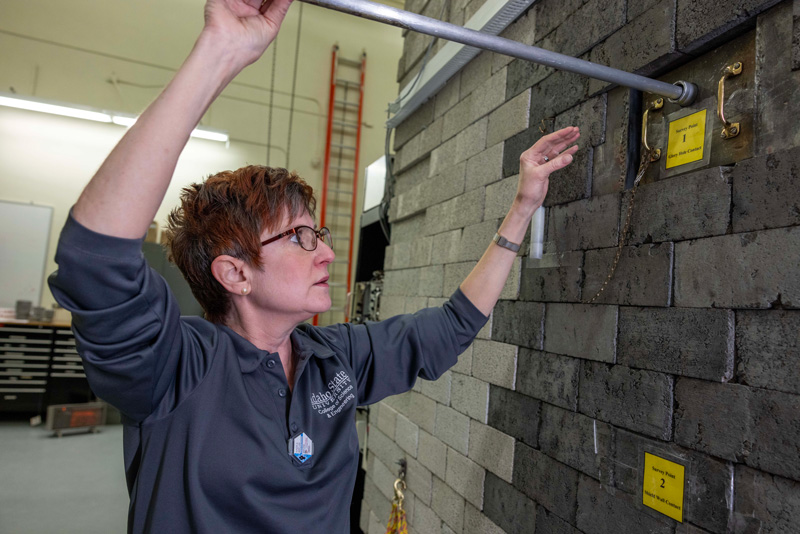
In the spring of 2026, ISU received authorization to host the NuCube Energy Advanced Research and Test Reactor (ART) through the Nuclear Energy Launch Pad USA program. Managed through the National Reactor Innovation Center, the program provides streamlined pathways for developers wanting to demonstrate advanced nuclear energy technology and accelerate commercial deployment.
“As we build and test the ISU ART reactor, we will also be developing the training program necessary to operate it, using the AGN-201 program as a template,” said Dan LaBrier, associate professor of nuclear engineering. “In that way, the AGN-201 reactor has laid the groundwork for bringing the NuCube Energy reactor to our campus and allows ISU to offer two unique experiences to a new generation of nuclear reactor operators.”
“The development of advanced reactors is being aggressively pursued,” said Pope. “Billions of dollars of private investment are being spent to make these reactors a reality. ISU’s nuclear engineering program, our nuclear reactor and our subcritical assembly place us in a perfect position to participate.”