
A Growing Partnership of Innovation
For decades, a powerful connection has been quietly shaping higher education and scientific innovation in Idaho.
The relationship between Idaho State University and the Idaho National Laboratory (INL) began in 1949, when the lab was first established as the National Reactor Testing Station. Today, that historic bond has grown into a massive partnership that is boosting the regional economy while strengthening the future of American energy leadership.
At the heart of this growth is a major milestone. In 2024, ISU became the first higher education institution in Idaho to sign the Strategic University Partnership for Education and Research, known as the SUPER Agreement, with the lab. This landmark five-year accord lays out a shared vision to tackle some of the country’s biggest challenges, opening new doors for students and faculty to work directly with world-class scientists on everything from energy-environmental security to securing the domestic supply chain for critical materials. The ripples of this agreement will be felt across Idaho for generations, positioning the state as a central hub for reliable and secure advanced energy solutions. By focusing on regional resource sustainability, the alliance brings federal investments into local technology hubs and creates cooperative ventures with the mining industry. This means the research conducted on campus and at the lab translates into direct economic development, creating high-paying jobs and keeping local talent in Idaho.
“Through the SUPER Agreement, Idaho State University and Idaho National Laboratory are building more than a research partnership - we are creating a long-term ecosystem for research, innovation, workforce development, and economic growth,” said Mustafa Mashal, who previously served as associate vice president for research and innovation partnerships at ISU. The impact of this collaboration is easy to see in the sheer number of people bridging the gap between the classroom and the research facility. Nationally, ISU holds the highest number of joint appointments with INL, allowing faculty researchers to seamlessly exchange ideas. Furthermore, the University serves as a primary talent pipeline, with more than 1,150 ISU alumni building successful careers within the lab’s workforce, proving that a local education prepares students for future job opportunities.
“We are seeing what is possible when education and innovation are fully aligned. ”
“With so many ISU alumni contributing to INL’s mission and researchers holding joint appointments that bridge academia and the national laboratory, we see what is possible when education and innovation are fully aligned,” Todd Combs, INL deputy laboratory director for science and technology and chief research officer said. “We are not just training the next generation. We are placing them at the center of INL’s vision to change the world’s energy future and secure our nation’s critical infrastructure.”
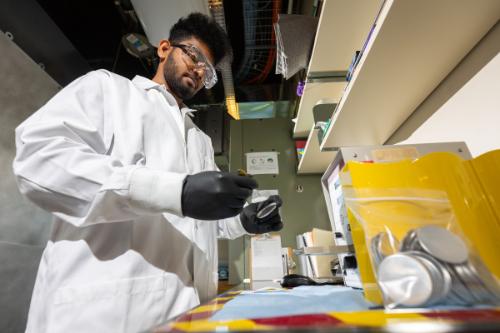
For students, this partnership transforms the college experience by turning the entire state into a living classroom. Through expanded internships, practicums, collaborative research programs and co-supervision, dozens of students from a variety of academic disciplines actively participate in industry roles, working side by side with world-renowned professionals. These pathways go far beyond traditional engineering roles and are not restricted to advanced doctoral candidates. Because the lab requires a varied workforce, students pursuing various degrees or certificates are finding immediate career opportunities in areas like technical operations, nuclear science and engineering, cyber-physical systems, business and accounting, mechanical engineering, health and occupational safety, and cybersecurity.
Describing the excitement of this hands-on environment, Martin Blair, ISU’s vice president for research and economic development, noted that, “The synergy between ISU and INL is transformative. As we integrate our academic and research expertise with the nation’s premier nuclear energy laboratory, we are creating an environment where students move seamlessly from the classroom to the forefront of national energy innovation, ensuring Idaho remains at the heart of America’s energy future.”
.jpg)
A major focus of their current joint research involves addressing the global supply risk of critical materials. These materials, minerals, and rare-earth elements are essential for modern technology, yet the United States currently relies heavily on foreign supplies to get them. By combining the University’s academic strengths in fields like the geosciences and chemistry with the lab’s advanced research capabilities, teams are exploring innovative ways to recover these minerals from various sources, including wastestreams from Idaho’s agriculture and mining industries.
At the same time, researchers are looking ahead to the next generation of reliable energy. As federal initiatives push to significantly increase nuclear power over the coming decades, ISU and INL are collaborating on the development and deployment of advanced nuclear reactors. By aligning their strengths, they are doing more than just solving complex technical problems; they are cultivating the next generation of Idaho scientists and skilled workers, fueling regional economic growth and reinforcing America’s energy leadership and national security in sectors that matter most.